




Cheek / Mid-Face Filler in Atlanta, GA
The mid-face is where a face stops looking tired. Restoring support across the cheek tends to read as rested and lifted rather than as treated — and because the cheek carries the tissue below it, softening the lines around the mouth is often a side effect rather than the target.
The Benefits
Support, Not Padding
It restores support rather than padding a line, so the change reads as looking rested instead of looking filled.
Helps The Fold Indirectly
Because the cheek carries the tissue below it, restoring mid-face support often softens the nasolabial folds without injecting the folds themselves.
Visible Right Away
Results are visible immediately, though swelling means the true result is not readable for about two weeks.
Fully Reversible
Hyaluronic acid filler is reversible, so a result you dislike or a lump that appears can be dissolved with hyaluronidase.
Built In Stages
The mid-face suits being built in stages: a small amount placed deep changes a lot, and can be reassessed before more is added.
Light And Shadow
Much of the improvement is a change in how light falls on the face, so it can look significant in person while being hard to point at.
No Surgical Recovery
There is no general anesthesia, no incision, and no surgical recovery; most people return to normal activity the same day.
Comfortable In Practice
Most modern fillers contain lidocaine and the area is numbed first, so treatment is generally well tolerated.
Real Results
Before & After
 After
After Before
 After
After Before
 After
After Before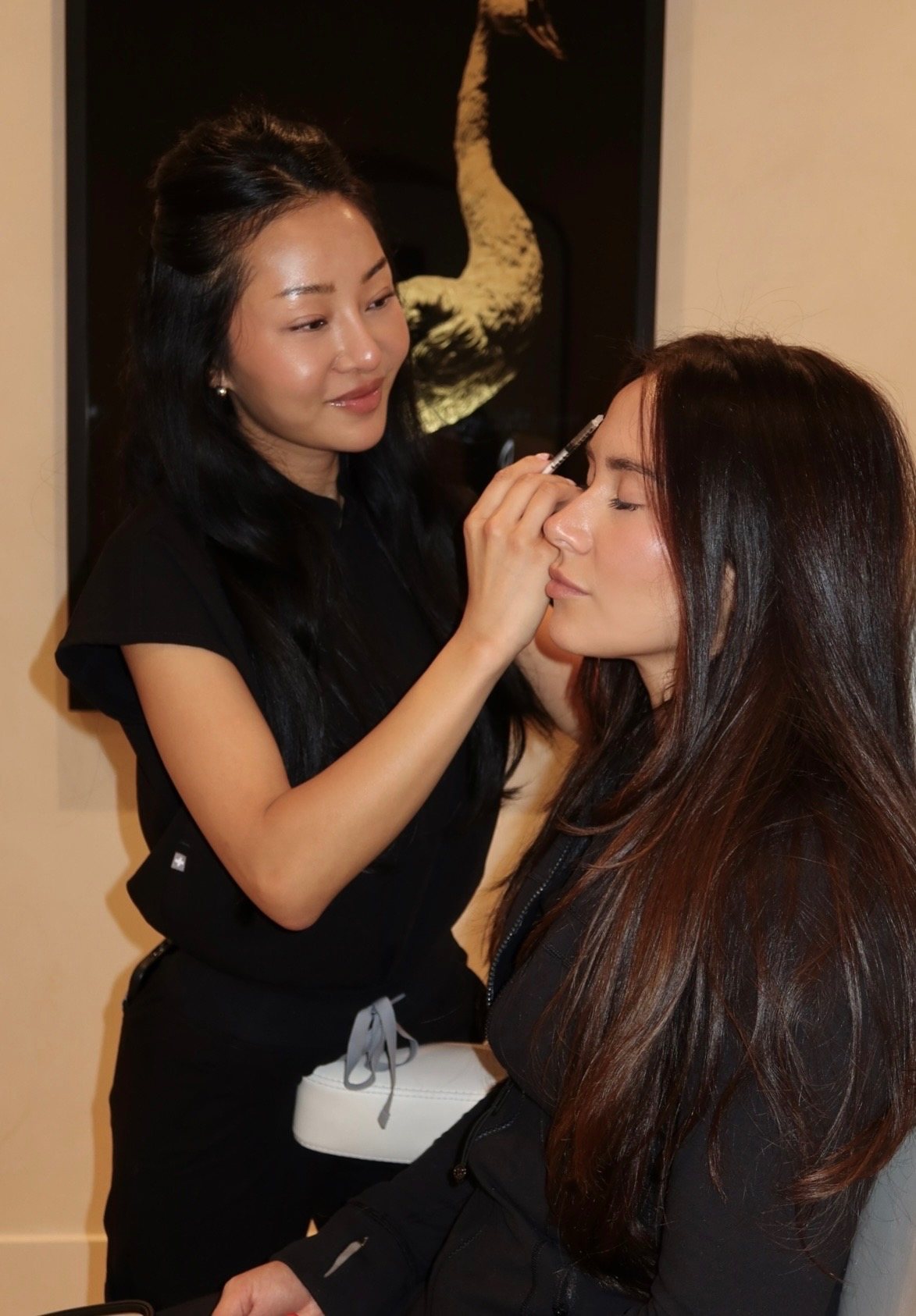
What Cheek / Mid-Face Filler Is
Cheek or mid-face filler is the everyday name for placing dermal filler across the cheekbone, the front of the cheek, and the flat area beside the nose. Most of this work is done with hyaluronic acid, a sugar molecule the body already makes and holds water with, manufactured as a clear cross-linked gel. The same region is also treated with collagen biostimulators such as poly-L-lactic acid, which build support gradually rather than supplying it immediately. Those are genuinely different tools, not competing brands of one thing.
The subject of the treatment is not really hollow cheeks. It is mid-face volume loss, which has two engines. The deep fat pads of the cheek shrink and slide downward with age, so volume that sat high and forward ends up low and inward. Underneath them the facial skeleton remodels: the maxilla recedes slightly, the eye socket widens, and the bony platform the cheek was draped over gets smaller. The result is less a hollow than a collapse of the scaffolding.
That is why this is described as restoring support rather than adding volume. Gel placed deep on bone gives the tissue above it something to sit on again; gel placed more superficially blends the contour. A well-planned mid-face uses both, in small amounts, following the shape that used to be there.

How It Works
Hyaluronic acid is hydrophilic — it attracts and binds water — so injected gel does not sit there as inert bulk. It draws in surrounding fluid and swells slightly, which is why a small volume changes contour more than its size suggests, and why the look keeps settling for a couple of weeks. Raw HA would clear within a day or two, so filler gels are cross-linked: chemical bridges between the chains turn a liquid into a stable gel that resists enzymatic breakdown.
In the mid-face the property that matters most is G-prime, a measure of how much a gel resists being deformed by the tissue around it. High G-prime gels are firm and hold their shape under pressure, which is what deep structural support against bone needs. Low G-prime gels are softer and spread more, which suits superficial blending where a firm gel would look like a ridge.
Depth follows from that. The supraperiosteal plane is the deepest — directly on the bone, beneath the muscle — where small boluses act like a shim under the whole mid-face, away from the more superficial vessels. The subcutaneous plane sits just under the skin and softens transitions. Deep placement gives lift, superficial placement gives smoothness, and most natural results use a little of each in that order.
Over the following months your own hyaluronidase and normal metabolic turnover break the gel down, and the mid-face returns toward baseline.

What Cheek / Mid-Face Filler Treats
Flattening of the cheekbone and mid-face
The cheek no longer catches light where it used to. Deep placement restores projection rather than adding width.
Nasolabial folds
The fold beside the mouth is often a downstream symptom of the cheek above it losing support, which is why an honest injector may propose treating the cheek when you asked about the line.
A tired or drawn look with no single obvious cause
Diffuse deflation reads as fatigue. Small, well-placed support changes the overall impression more than treating any one line.
Loss of definition along the lower face
Descended tissue collects near the jaw. Restoring support higher can sharpen the lower face, though it does not replace jawline treatment or fix true laxity.
Under-eye shadow that begins below the eye
Some tear-trough hollowing is really a mid-face deficiency, and supporting the cheek lifts the transition. Deciding which layer is at fault is the skill of the assessment.
Volume loss after significant weight change or illness
Facial fat is lost early and returns last. Filler restores contour without waiting for that to correct itself.
Proportions that read as bottom-heavy
Restoring the upper cheek shifts visual weight upward, which is much of what makes a result look natural instead of full.
Is Cheek / Mid-Face Filler Right For You?
You May Be A Good Candidate If
- You have genuine mid-face volume loss or flattening, rather than skin laxity as your main concern.
- You want more support and better proportion, not a bigger or wider cheek.
- You are in generally good health, past facial growth, and not pregnant or breastfeeding.
- You accept swelling and possible bruising, and have not booked days before a wedding or photographed event.
- You are open to treating the cheek even if you arrived asking about the lines beside your mouth.
- You understand results are temporary, and you will report anything that looks or feels wrong immediately.
This May Not Be Right For You If
- You are pregnant, breastfeeding, or trying to conceive; fillers have not been studied in these groups and treatment is deferred.
- You have an active infection, inflammation, breakout, or open wound in or near the area; treatment waits until it resolves.
- You have a known hypersensitivity to hyaluronic acid, to lidocaine or other amide anesthetics, or to any component of the gel.
- You have a history of severe allergy or anaphylaxis, which changes the risk profile and requires careful assessment first.
- You have an active or poorly controlled autoimmune or connective-tissue disease, or take immunosuppressive therapy; these need clearance and individual judgment.
- You have a bleeding disorder, or take anticoagulant or antiplatelet medication that cannot be safely paused.
- Your main problem is sagging rather than deflation — past a certain point only a surgical or energy-based approach addresses laxity honestly.
- You have had permanent or semi-permanent filler placed in the area, which complicates assessment and cannot be dissolved.
The most useful thing a consultation does is decide what is actually deficient, and in which layer. Assessment looks at bone projection, fat-pad position, skin quality, and how your face moves — not at a photograph of someone else's cheekbones. Two honest answers come up often: that the cheek should be treated instead of the fold you came in about, and that filler is the wrong tool because the real problem is laxity.
How Cheek / Mid-Face Filler Compares
The mid-face can be treated with an immediate volumizer, with a biostimulator that builds your own collagen slowly, or surgically with your own fat. They do different jobs on different timelines, and only one can be undone.
| Feature | HA cheek filler | Sculptra (biostimulator) | Fat transfer |
|---|---|---|---|
| What it is | A cross-linked hyaluronic acid gel that occupies space under the skin or on bone | Poly-L-lactic acid microparticles that signal your body to build collagen, with no lasting volume of their own | Your own fat, harvested by liposuction and grafted into the mid-face |
| Best suited for | Projection and defined contour in a specific place, with real control over shape | Broad, diffuse volume loss and overall skin firmness | Large-volume restoration in a single surgical stage |
| Result appears | Immediately; readable at about two weeks once swelling settles | Gradually, over roughly three to six months as collagen forms | Immediately but heavily swollen; months to settle |
| Typical course | One session, refined at a follow-up as desired | A series, commonly around three sessions spaced weeks apart | One surgical procedure, occasionally repeated |
| Reversible | Yes — hyaluronidase dissolves it within days. A genuine safety net | No; it must run its course over roughly two years | No, not without further surgery |
| How long it lasts | Commonly about 12 to 18 months here, longer than in mobile areas like the lips | Often up to about two years after the series | Potentially years for the fat that survives, though the amount is unpredictable |
| Signature risk | Vascular occlusion, lumps, an overfilled look — most addressable with hyaluronidase | Delayed-onset nodules, with no dissolving agent available | Surgical risk, irregularity, and unpredictable graft survival |
None is better in the abstract, and combining them over time is common. The row worth reading twice is reversibility: an HA result you dislike is fixable in an afternoon, and the other two are not. That is a strong argument for starting conservatively with the reversible option in an area this visible.
What To Expect
Before The Treatment
- Consultation and facial assessment: health history, medications, allergies, and any previous filler — including where, when, and what, since old product here can persist longer than people expect.
- Agreement on a plan and a plane: whether the target is deep structural support on bone, superficial blending, or both, and whether the cheek is being treated for itself or for something below it.
- Pause what you safely can, with your prescriber's permission: aspirin, NSAIDs, fish oil, and vitamin E are commonly stopped for several days to reduce bruising. Never stop a prescribed anticoagulant on your own.
- Skip alcohol for about 24 hours beforehand, since it dilates blood vessels and makes bruising more likely.
- Leave two to four weeks before anything photographed, and schedule around dental work and other facial treatments.
Results: Onset And How Long It Lasts
You will see the change immediately, but that first look includes swelling and usually looks fuller than the finished result. Most swelling settles within a week, and the mid-face reads as the true result at about two weeks. Filler here is relatively static compared with the lips, so it lasts longer — commonly about 12 to 18 months, depending on product, placement, and metabolism.
During The Treatment
- The skin is cleansed and disinfected, and photographs are usually taken so you can compare before and after honestly rather than from memory.
- Topical numbing is applied for roughly 15 to 30 minutes. Most mid-face fillers also contain lidocaine, which keeps numbing the area as product goes in.
- Injection points are marked and the anatomy reviewed deliberately. The mid-face contains the infraorbital and angular arteries, so mapping vessels and staying in known-safer planes is part of the procedure, not a formality.
- For structural support, small boluses are typically placed with a needle directly on bone in the supraperiosteal plane, with slow injection and aspiration as vascular precautions. For blending, a blunt-tipped cannula is often used instead, since it pushes vessels aside rather than piercing them.
- Product goes in small increments, with pauses to sit you upright, view the face in motion, and check symmetry.
- The area is gently massaged and iced. The visit usually runs 30 to 60 minutes, most of it numbing and planning rather than injecting.
How Often, And Why
Most people return for mid-face filler every 12 to 18 months, longer than for lips, because the cheek is comparatively static and often treated with firmer product placed deep. The exact interval depends on the gel, the amount and depth, your age, and your metabolism.
The more useful point is that mid-face work is cumulative in a way lips are not. Product placed on bone resorbs slowly, and some can persist past the point where you still see its effect. Adding a full correction every year on top of that is how a cheek becomes wider and flatter than the face it belongs to. A reasonable cadence is a full plan at the start, reassessment at two weeks, then smaller refreshes when support softens.
Afterward
- Apply ice or a cold compress in short intervals for the first day, using gentle pressure only.
- Expect swelling to peak in the first 24 to 72 hours, and the two sides to swell at different rates. Early asymmetry is normal.
- Avoid strenuous exercise, hot yoga, saunas, steam rooms, and hot tubs for 24 to 48 hours; heat and raised blood pressure worsen swelling and bruising.
- Skip alcohol for about 24 hours, and avoid pressing, rubbing, or resting your face on your hands for the first few days.
- Sleep on your back with your head elevated for two or three nights, and avoid face-down massage tables for about a week.
- Skip makeup over the injection points for 12 to 24 hours, avoid facials, microneedling, and laser over the area for roughly two weeks, and keep your follow-up — mid-face work is commonly reassessed at two weeks.
Side Effects And Downtime
Common And Expected
- Swelling, which is expected, peaks at 24 to 72 hours and can make the cheek look fuller and less even than the eventual result.
- Bruising, from a pinpoint dot to a larger patch, which can take up to about two weeks to clear and is usually coverable with makeup after the first day.
- Tenderness, aching, or a firm, heavy sensation for several days, especially where product was placed deep on bone.
- Small lumps or unevenness, often easier to feel than see, most of which settle within two to four weeks.
- Temporary asymmetry, since the two sides rarely swell at the same rate.
- Redness, pinpoint injection marks, and a brief sense of pressure across the cheekbone or under the eye.
When To Seek Care
- Severe, escalating, or disproportionate pain — especially pain that worsens rather than improves after the first several hours. Pain out of proportion to the procedure is the classic early warning.
- Blanching: skin that turns white, pale, or grey, or a pale patch that does not refill with color when pressed.
- Dusky, mottled, purple, or net-like discoloration anywhere on the cheek, nose, under-eye, or upper lip, or skin that feels cold to the touch.
- Any vision change at all — blurred or double vision, a dark spot, partial or complete vision loss, eye pain, drooping, or altered eye movement. This is an emergency: go to an emergency department immediately and call your injector on the way, because treatment is time-critical.
- Signs of infection such as spreading redness, warmth, pus, or fever, or a firm painful lump appearing days to weeks later.
- New numbness, weakness, or asymmetry of movement that does not resolve as the anesthetic wears off.
Less Common, But Important To Know
- Vascular occlusion: filler entering or compressing a blood vessel and blocking blood flow to the tissue it supplies. This is the most serious risk of mid-face filler, and the mid-face is a high-risk region because it contains the infraorbital and angular arteries, which connect through anastomoses to the vessels supplying the eye. Filler reaching one of those has caused permanent vision loss, and more commonly it causes skin death (necrosis) and scarring. It is uncommon, but it is a medical emergency requiring immediate high-dose hyaluronidase, and delay makes the outcome worse.
- Infection at the injection site, which may need antibiotics and rarely involves an abscess or biofilm.
- Delayed-onset nodules or granulomas: firm lumps appearing weeks to months later, sometimes triggered by illness, dental work, or vaccination, and typically managed with hyaluronidase or steroids.
- Persistent puffiness or a bluish tinge where product sits too superficially or too close to the under-eye, which usually needs dissolving rather than waiting out.
- An overfilled, wide, or flat appearance from too much volume or the wrong gel for the plane — the familiar cause of a mid-face that looks heavy rather than lifted.
- Nerve irritation causing temporary numbness or altered sensation, most often near the infraorbital nerve below the eye.
- Allergic or hypersensitivity reaction to the gel or the lidocaine within it, from persistent swelling to, very rarely, a severe systemic reaction.
Downtime
There is no downtime in the surgical sense, and most people return to normal activity the same day. The social downtime is swelling for two to three days, when the cheek can look fuller and slightly uneven, plus possible bruising that lasts longer. Plan a day or two away from hard exercise and heat, and expect the face to keep refining for a full two weeks — which is why nothing is assessed or topped up before then.
Who Performs This Treatment

Helen Zhang
Master Injector · Neuromodulators, filler, biostimulators and facial balancingHelen is one of Alcove's master injectors. Your appointment starts with an assessment of your face and your goals, and your plan is built from that conversation rather than from a menu.

Sharon Williams
Master Injector · Neuromodulators, filler, biostimulators and facial balancingSharon is one of Alcove's master injectors. Your appointment starts with an assessment of your face and your goals, and your plan is built from that conversation rather than from a menu.

Xing Xing Li
Master Injector · Neuromodulators, filler, biostimulators and facial balancingXing Xing is Alcove's master injector. Your appointment starts with an assessment of your face and your goals, and your plan is built from that conversation rather than from a menu.
Cheek / Mid-Face Filler FAQs
Because the fold is often a symptom rather than the problem. When the cheek above loses volume, tissue descends and stacks at the fold, deepening it. Restoring support higher up lifts that tissue and often softens the fold indirectly — a more natural result than packing product into the crease.
Commonly about 12 to 18 months. Mid-face filler generally outlasts lip filler because the cheek moves far less and is often treated with firmer gels placed deep on bone, where they break down more slowly. Product, depth, metabolism, and exercise all shift the number.
Not when the amount is conservative and the plane is right. The pillowed look comes from too much volume, placement that is too superficial or too far forward, or repeated top-ups before previous filler has resolved. Projection high on the cheekbone reads as lift; volume on the front of the cheek reads as width.
There is no set amount. Your provider places what your anatomy needs to restore support, and that is decided at an in-person assessment. Deep placement is efficient, so the result often takes less than people expect.
It is usually described as pressure rather than sharp pain. Topical numbing is applied first and most fillers contain lidocaine. Injections onto bone can feel like a dull ache or a brief crunching sensation, which is normal. Expect tenderness for a few days afterward.
It is a medical procedure with real risk, not a beauty service. The mid-face contains the infraorbital and angular arteries, which connect to the vessels supplying the eye, so vascular occlusion here can cause skin necrosis and, rarely, permanent vision loss. It is uncommon — and it is why anatomical knowledge and immediate access to hyaluronidase matter more than price.
Both are legitimate and often used in one visit. A needle allows precise deep deposits on bone for structural support. A blunt cannula pushes vessels aside instead of piercing them and generally bruises less, which suits blending. The choice follows the plane being treated.
Sometimes, and it is often the safer first move. A shadow under the eye can come from the mid-face below it losing support, and restoring the cheek lifts the transition. Under-eye skin is thin and unforgiving, so treating the cheek first and reassessing is a conservative sequence.
Yes, if it is hyaluronic acid. Hyaluronidase breaks the gel down within hours to days, correcting overfilling, lumps, and misplacement, and it is the urgent treatment for a vascular occlusion. Biostimulators such as poly-L-lactic acid cannot be dissolved, which matters when choosing between them.
It depends on whether you want a defined contour or overall support. HA filler is precise, immediate, and reversible, which suits restoring projection in one place. A biostimulator builds your own collagen over months and suits broad, diffuse volume loss, but cannot be undone. Many people use both over time.
Mid-face filler is generally priced per syringe rather than per appointment, so the total depends on how much product your plan needs and which product is chosen. Because the amount is a clinical decision made in person, an accurate figure comes from a consultation rather than from a page.
G-prime describes how much a gel resists being deformed by surrounding tissue. A high G-prime gel is firm and holds its shape under pressure, which is what deep support on the cheekbone needs. A softer gel spreads more and suits superficial blending. Using a firm gel too superficially is a common reason filler looks like a ridge.
Pairs Well With


Book Your Consultation
A consultation is a conversation about your face, not a sales appointment. Bring your questions about Cheek / Mid-Face Filler and your medical history, and leave with an honest answer about whether it is the right treatment for you.