




Chin Filler in Atlanta, GA
When the chin carries its share of the profile, the whole lower face reads differently: the jaw looks defined rather than soft, the neck looks longer, and the lips no longer appear to sit ahead of everything else. It is one of the smallest changes in injectable aesthetics with one of the largest effects on a face seen from the side.
The Benefits
A Whole-Profile Change
A small change in one place alters the whole profile, because the chin is what the lips, nose, and jawline are read against.
Small Volume, Large Effect
The volumes involved are modest next to the visual effect, part of why the chin is reported as one of the more satisfying filler areas.
Visible The Same Day
Projection appears the moment the gel is placed, so the profile can be assessed from the side during the appointment.
Fully Reversible
Hyaluronic acid filler is reversible; if the shape is not what you wanted, an injector can dissolve it with hyaluronidase.
No Implant, No Incision
There is no implant, no incision, and no surgical recovery, and most people return to normal activity the same day.
A Preview Before Surgery
For anyone weighing a chin implant, filler offers a temporary preview of more projection before committing to something permanent.
Balance, Not Bulk
Because the goal is proportion rather than size, a good result reads as a stronger jaw, not as a treated chin.
Builds With The Jawline
It combines naturally with jawline and cheek treatment, where the aim is a continuous contour rather than one isolated feature.
Real Results
Before & After
 After
After Before
 After
After Before
 After
After Before
What Chin Filler Is
Chin filler is the everyday name for augmenting the chin with an injectable gel, most often a hyaluronic acid dermal filler. Hyaluronic acid is a sugar molecule your body already produces, manufactured for injection as a clear, cross-linked gel. The chin is also treated with calcium hydroxylapatite, a firmer injectable made of mineral microspheres in a gel carrier, which lasts well but cannot be dissolved.
What makes the chin unusual is that the target is a shape rather than a hollow. The gel is not placed near the surface to plump skin; it goes deep, onto the periosteum, the tough membrane covering the jawbone, where it acts as a shim that pushes the tissue above it forward. A soft gel of the kind used to hydrate a lip would simply flatten under the weight of what sits on top.
The underlying issue is usually skeletal. A chin that is small is called microgenia; one positioned too far back is retrogenia. Both are common, both are inherited more often than acquired, and both often go unnoticed until someone sees a photograph of themselves in profile.
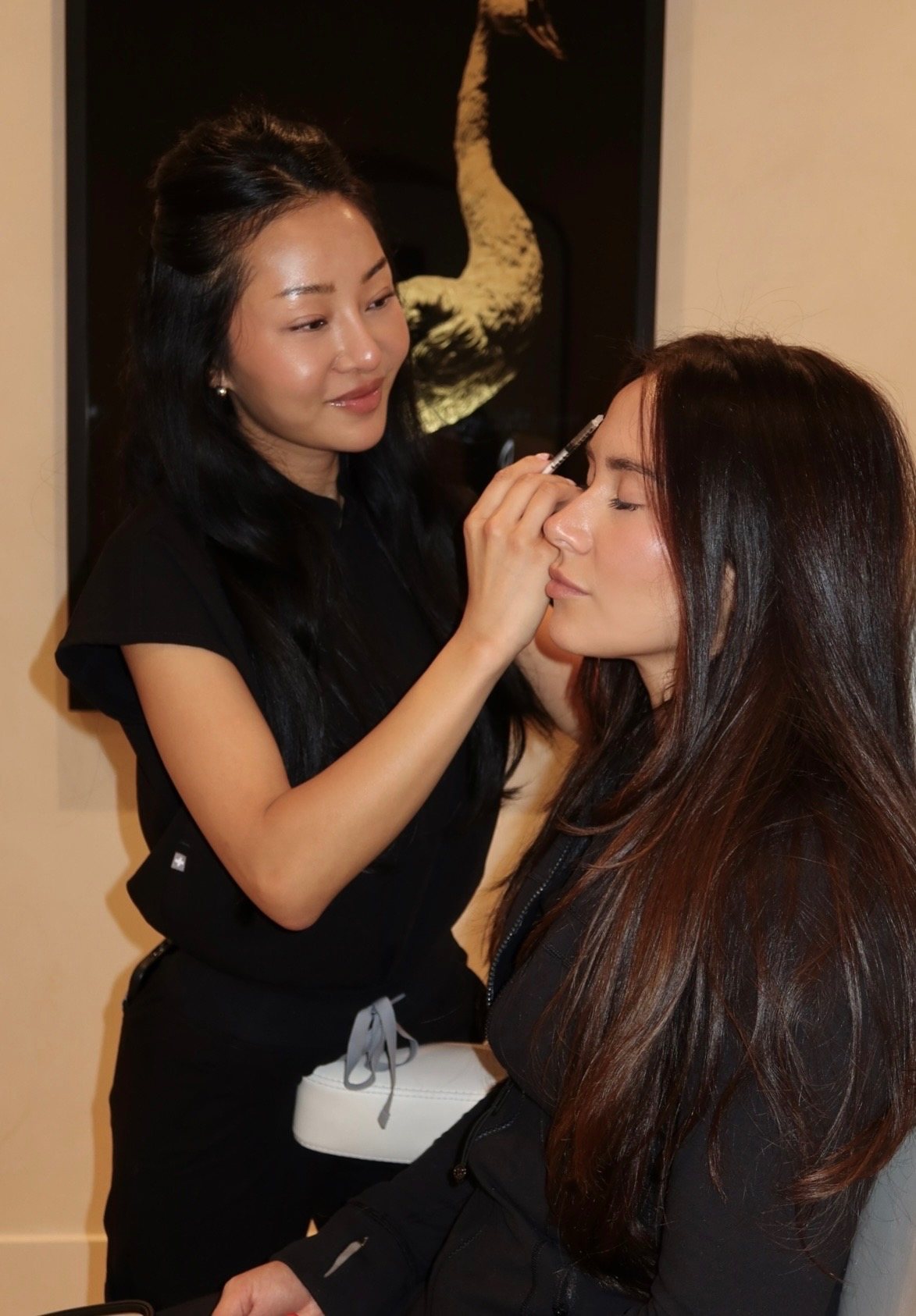
How It Works
Hyaluronic acid is hydrophilic: it attracts and holds water, and that water-binding creates volume. Raw HA would break down within a day or two, so injectable gels are cross-linked — chemical bridges between the HA chains turn a free-flowing liquid into a cohesive gel that resists enzymatic breakdown.
The property that matters most in a chin is G-prime, a measure of how strongly a gel resists being deformed by the tissue pressing on it. High G-prime gels are firm and hold their shape under load, which is what projection requires; softer gels spread and settle. Placement does the rest. A firm gel deposited on the periosteum has something rigid to push against, and because it sits deep in an area that barely moves, it tends to stay put and outlast filler in mobile regions.
The boundary is worth stating plainly. Filler augments soft-tissue and bony contour; it does not move the jaw. A chin can be given a more balanced outline, but the skeletal relationship between the upper and lower jaw is unchanged. Where retrusion is significant, or the bite itself is the problem, the honest conversation is about orthognathic surgery or an implant.

What Chin Filler Treats
A recessed or short chin
A chin sitting behind the plane of the lips reads as weak from the side. Deep structural placement projects the tissue forward so the lower third finishes the face.
A profile out of balance with the lips and nose
Assessment often uses the Ricketts E-line, an imaginary line from the nose tip to the front of the chin that the lips should sit close to. When the chin is set back, normal lips look protrusive.
A jawline that looks soft at a normal weight
The chin is the front anchor of the jaw. Without projection there, the jawline has nothing to run toward, so it reads as rounded however lean someone is.
A full-looking area under the chin in a slim face
A recessed chin blunts the angle where chin meets neck, which can read as a double chin with very little fat present. Projecting the chin sharpens that angle.
A vertically short chin
Height, not only forward projection, is part of chin proportion. A short chin compresses the lower face, and carefully extended placement can lengthen it slightly.
Chin asymmetry
Most chins are marginally off-center. Placing different amounts on each side is comparatively straightforward, because the landmarks are firm bone rather than mobile tissue.
Age-related loss of chin and jaw contour
The lower jaw resorbs slowly with age, so the chin loses projection and the tissue over it has less to sit on. Restoring contour often does more than treating skin.
A deep crease below the lower lip
The labiomental crease deepens as the chin recedes. Support beneath it can soften the fold, though a heavy hand here looks worse than doing nothing.
Is Chin Filler Right For You?
You May Be A Good Candidate If
- You are in generally good health, past adolescent facial growth, and not pregnant or breastfeeding.
- Your concern is visible in profile: a chin that reads as small, set back, or short.
- You want more definition through the lower face without surgery, and you accept a temporary result.
- Your expectations are proportional — balance within your own anatomy, not a different jaw.
- You accept swelling and possible bruising, and have not booked days before a wedding or photo shoot.
- You are open to hearing that jawline or cheek support may belong in the plan too.
This May Not Be Right For You If
- You are pregnant, breastfeeding, or trying to conceive; fillers have not been studied in these groups.
- You have significant skeletal retrusion or a bite problem. Filler cannot reposition a jaw, and the right conversation is surgical.
- You have an active infection, inflammation, cold sore, or open wound near the chin or mouth.
- You have a known hypersensitivity to hyaluronic acid, to lidocaine or other amide anesthetics, or to any component of the gel.
- You have a history of severe allergy or anaphylaxis, which changes the risk profile before any injectable.
- You have a bleeding disorder, or take anticoagulant or antiplatelet medication that cannot be safely paused.
- You have an active or poorly controlled autoimmune or connective-tissue disease, or take immunosuppressive therapy.
- You want the profile of a specific photograph, or someone else is pushing you toward treatment.
The chin is where sex-specific proportion matters more than almost anywhere else, so it deserves an explicit conversation. A broader, squarer, more forward chin reads as masculine; a narrower, more measured one reads as feminine. Overfilling a chin, or building width when only projection was needed, is a recognized way to masculinize a face by accident, and a common reason people ask for filler to be dissolved.
How Chin Filler Compares
Three approaches change chin projection, and they are not interchangeable. HA filler adds a reversible gel on top of the bone. Calcium hydroxylapatite adds a firmer material that also stimulates collagen but cannot be dissolved. An implant or genioplasty changes the skeletal framework itself.
| Feature | HA chin filler | Calcium hydroxylapatite | Chin implant / genioplasty |
|---|---|---|---|
| What it is | A cross-linked HA gel, usually a firm high G-prime formulation, placed deep on bone | Mineral microspheres in a gel carrier; volumizes immediately, then stimulates collagen | Surgery: a shaped implant fixed to the chin bone, or the bone cut and repositioned |
| How projection happens | The gel sits between bone and soft tissue and pushes the tissue forward | The same principle, with a stiffer material that resists tissue pressure well | The bony contour is genuinely enlarged or moved, so the change is structural |
| Onset | Immediate; true shape readable once swelling settles at about two weeks | Immediate from the carrier, then evolving as collagen replaces it | Immediate in principle, but months of swelling before the contour is clear |
| Typical duration | Commonly about 12 to 18 months here, longer than filler in mobile areas | Commonly about 12 to 18 months or more, depending on placement | Permanent, unless an implant is later removed or exchanged |
| Reversibility | Reversible with hyaluronidase, usually within days — a genuine safety net | Not dissolvable with hyaluronidase; it must resorb on its own | Only by further surgery |
| How much change is possible | Modest to moderate; good for mild and moderate recession, limited beyond that | Modest to moderate, with a firmer edge to the contour | The only option for significant retrusion, lengthening, or correcting a bite |
| Signature risk | Vascular occlusion, migration beyond the intended footprint, an overbuilt or masculinized shape | Nodules and vascular occlusion, with no dissolving agent available | Infection, implant malposition, and mental nerve injury with lasting numbness |
The row deserving most attention is reversibility: starting with HA means a result you dislike is correctable in an afternoon, and it doubles as a low-commitment way to find out whether you like more projection at all. The row that sets the ceiling is how much change is possible — filler is good at mild and moderate recession, and is not the answer for a large skeletal deficit, however much product is offered.
What To Expect
Before The Treatment
- Consultation and profile assessment. Expect to be examined and photographed from the side as well as the front, since a chin cannot be judged face-on.
- A conversation about the boundary. If your chin is significantly retruded or your bite is involved, a good provider will say so and discuss surgery rather than promise a result filler cannot give.
- Medical history review: allergies, medications and supplements, previous filler in the lower face — where, when, and what — and any history of cold sores.
- Pause what you can safely pause, with your prescriber's permission. Aspirin, non-essential anti-inflammatories, fish oil, and vitamin E are commonly stopped for several days to reduce bruising. Never stop a prescribed anticoagulant on your own.
- Skip alcohol for about 24 hours beforehand, and leave two to four weeks of margin before any photographed event.
Results: Onset And How Long It Lasts
You will see more projection immediately, but the first days include swelling that overstates it. The chin usually looks firmest and least settled for two or three days, softens noticeably within a week, and reads as the true profile at about two weeks. Because the gel sits deep in an area that moves very little, results here commonly last around 12 to 18 months.
During The Treatment
- The chin is cleansed and disinfected, and photographs are taken front-on and in profile so the result can be judged honestly rather than from memory.
- Topical numbing cream is applied for roughly 15 to 30 minutes. Most structural HA gels also contain lidocaine, which keeps numbing as the product goes in.
- Your provider marks the plan on your skin: where projection is needed, where height is needed, and which areas to avoid, including the mental nerve and the vessels crossing the region.
- The gel is placed deep, onto the periosteum, as small boluses through a needle or a blunt-tipped cannula. Slow injection, low pressure, aspiration, and small increments are standard precautions against injecting into a vessel.
- You are sat upright partway through and shown your profile in a mirror, because a chin assessed while lying flat is assessed wrongly. The area is then molded and iced; visits usually run 30 to 60 minutes.
How Often, And Why
Chin filler generally lasts longer than filler in mobile areas, for mechanical reasons: the gel sits deep against bone in a region that barely moves, and firmer products resist breakdown better than soft ones. Most people find the result holds for roughly 12 to 18 months, varying with the product, the amount placed, and individual metabolism.
A sensible pattern is to review at about two weeks, add a small amount then if the profile needs it, and afterward return when the definition softens rather than on a fixed calendar. Deep filler can persist beyond the point where it is visibly doing anything, so adding a full dose on top of old product every year is how a chin gradually becomes wider and heavier than anyone intended.
Afterward
- Ice or a cold compress in short intervals for the first day, using light contact rather than pressure.
- Expect swelling to peak within 24 to 72 hours. Chin swelling exaggerates projection, so the early look is not the result.
- Do not press or rest your chin on your hand, and avoid anything that compresses the area — mouthguards, chin straps, face-down massage tables — for a week or two.
- Avoid strenuous exercise, hot yoga, saunas, and hot tubs for 24 to 48 hours; heat and raised blood pressure worsen swelling and bruising.
- Sleep on your back with your head slightly elevated for the first two or three nights so swelling drains rather than pools.
- Skip makeup over the injection points for about 24 hours, avoid facials, laser, and dental work near the area for roughly two weeks, and keep the two-week review appointment.
Side Effects And Downtime
Common And Expected
- Swelling over the chin, expected, peaking at 24 to 72 hours and often making the projection look greater than the final result.
- Bruising, from a pinpoint mark to a larger purple patch, which can take up to about two weeks to clear.
- Tenderness, aching, or a firm, tight sensation for several days, particularly when talking or chewing.
- Palpable firmness where a bolus was placed, usually easier to feel than see, typically softening over two to four weeks.
- Temporary asymmetry, redness, pinpoint injection marks, and occasional mild itching while everything settles.
When To Seek Care
- Severe, escalating, or disproportionate pain, especially pain that worsens rather than improves after the first hours.
- Blanching: skin turning white, pale, or grey, or a patch that does not refill with color when pressed.
- Dusky, mottled, purple, or net-like discoloration over the chin, lower lip, or under the jaw, or skin that feels cold.
- Any vision change at all, including blurred vision, vision loss, or eye pain. This is an emergency: go to an emergency department and call your injector on the way.
- New or persistent numbness, tingling, or loss of sensation in the chin or lower lip.
- Spreading redness, warmth, pus, or fever, or a firm painful lump appearing days to weeks later.
Less Common, But Important To Know
- Vascular occlusion: filler entering or compressing a blood vessel and cutting off blood supply to the tissue it feeds. This is the most serious risk of any filler, and the submental artery below the jaw and the inferior labial artery near the lower lip both run through the working area. Untreated, it can cause tissue death and scarring, and in rare cases filler reaching a vessel connected to the ocular circulation has caused vision loss. It is a medical emergency requiring immediate hyaluronidase.
- Migration: gel spreading beyond where it was placed, which here can blur the outline, drift toward the jawline, or produce a shelf that shows when you talk. It is associated with overfilling, superficial placement, and stacking product over years, and is treated by dissolving.
- An overbuilt or over-widened result, which can look heavy or masculinize a profile. This is a planning problem rather than a product failure, and it is reversible with hyaluronidase.
- Mental nerve irritation, producing numbness, tingling, or altered sensation in the chin and lower lip. Usually temporary, but always worth reporting.
- Infection at an injection site, occasionally an abscess or biofilm, which may need antibiotics or more involved treatment.
- Delayed-onset nodules: firm lumps appearing weeks to months later, sometimes triggered by illness, dental work, or vaccination, and usually managed with hyaluronidase or steroids.
- Allergic or hypersensitivity reaction to the gel or the lidocaine within it, from persistent swelling to, rarely, a severe systemic reaction.
Downtime
There is no downtime in the surgical sense; most people return to work the same day. Social downtime is mild — swelling for two or three days, during which the chin feels firm and can look slightly overprojected. Bruising is the unpredictable part and may linger up to about two weeks, though it is usually coverable after the first day. The shape keeps settling for two weeks, which is why a result is not refined before then.
Who Performs This Treatment

Helen Zhang
Master Injector · Neuromodulators, filler, biostimulators and facial balancingHelen is one of Alcove's master injectors. Your appointment starts with an assessment of your face and your goals, and your plan is built from that conversation rather than from a menu.

Sharon Williams
Master Injector · Neuromodulators, filler, biostimulators and facial balancingSharon is one of Alcove's master injectors. Your appointment starts with an assessment of your face and your goals, and your plan is built from that conversation rather than from a menu.

Xing Xing Li
Master Injector · Neuromodulators, filler, biostimulators and facial balancingXing Xing is Alcove's master injector. Your appointment starts with an assessment of your face and your goals, and your plan is built from that conversation rather than from a menu.
Chin Filler FAQs
Your profile. Filler placed deep on the chin bone pushes the tissue above it forward and, if needed, slightly downward, so the chin finishes the lower face instead of falling away. From the side the jaw looks more defined, the angle under the chin sharper, and the lips better balanced.
Commonly around 12 to 18 months, often longer than filler in the lips. The chin barely moves, the gel is placed deep against bone, and structural products resist breakdown, all of which slows how quickly it is metabolized.
That is decided in person, since it depends on how much projection is missing and what your tissue will hold. In general it takes more than a lip treatment and less than a full jawline, and it is often built over two visits rather than all at once.
Most people describe pressure rather than sharp pain. Topical numbing is applied beforehand, and structural gels usually contain lidocaine that numbs further as they go in. Injecting down onto bone produces a deep, dull sensation some find more noticeable than the needle.
It can improve how one looks. A recessed chin blunts the angle where the chin meets the neck, which reads as fullness even in slim people, and projecting the chin sharpens that angle. If there is genuine fat under the chin, filler will not remove it.
It can, if it is overdone or built in the wrong direction. Width and heavy forward projection read as masculine; a narrower, more measured shape reads as feminine. Have that conversation explicitly before anything is injected. If it does happen, HA filler can be dissolved.
Filler is temporary, reversible, done in one appointment, and handles mild to moderate recession well. An implant or genioplasty is permanent surgery that changes the bony framework, and it is the only real option for significant retrusion, lengthening, or a bite problem.
Yes. Gel can spread beyond its intended footprint, which here may blur the outline, drift toward the jawline, or show as a shelf when you talk. It is associated with overfilling, superficial placement, and stacking new product on old, and it is treated by dissolving.
The Ricketts E-line is a simple reference: an imaginary line from the tip of the nose to the front of the chin. In a balanced profile the lips sit close to it. When the chin is set back, the lips fall well in front, which is why a recessed chin can make normal lips look protrusive.
Chin filler is generally priced by the amount of product used rather than per appointment, so the total depends on how much projection is being built and which type of gel suits your anatomy. Because that is a clinical decision made in person, an accurate figure comes from a consultation.
Hyaluronic acid filler has a good safety record here and is reversible, but it is a medical procedure with real risks. Swelling and bruising are expected. Uncommon but serious complications include vascular occlusion — the submental and inferior labial arteries run through the area — infection, delayed nodules, and temporary nerve symptoms.
Usually the chin, because it is the front anchor the jawline runs toward; building the jaw without projection at the front can look wide rather than defined. Many plans treat both, and staging them lets each change be judged on its own.
Pairs Well With

Book Your Consultation
A consultation is a conversation about your face, not a sales appointment. Bring your questions about Chin Filler and your medical history, and leave with an honest answer about whether it is the right treatment for you.