



SkinPen Microneedling in Atlanta, GA
Smoother texture, softened acne scarring, and skin that reads as denser rather than merely polished. Microneedling is one of the few treatments that changes the structure of your skin instead of its surface, and because the improvement is collagen your own body built, it holds.
The Benefits
Your Own Collagen
The improvement is your own collagen and elastin, so it is a genuine change in skin quality rather than a temporary surface polish.
Cleared For Acne Scars
SkinPen was the first microneedling device FDA-cleared for treating facial acne scars in adults 22 and older, so the leading use has a regulatory basis rather than only a marketing one.
Cumulative By Design
Results are cumulative across a series, so each session builds on the last instead of resetting.
Suits Every Skin Tone
Because the injury is mechanical rather than light or heat energy, it suits all Fitzpatrick skin types, including deeper tones that carry higher risk with many lasers.
Short, Predictable Recovery
Recovery is measured in days, not weeks: flushed for a day or two, slightly dry for a few more.
More Than The Face
It is not limited to the face. Neck, chest, hands, abdomen, and thighs are all commonly treated.
Better Absorption
Fresh microchannels let appropriate serums reach past the skin barrier, which is why microneedling pairs well with delivery-based add-ons.
Combines Well
It fits alongside neuromodulators, biostimulators, and resurfacing facials as the structural layer of a longer plan.
Real Results
Before & After
 After
After Before
 After
After Before
 After
After Before
 After
After Before
 After
After Before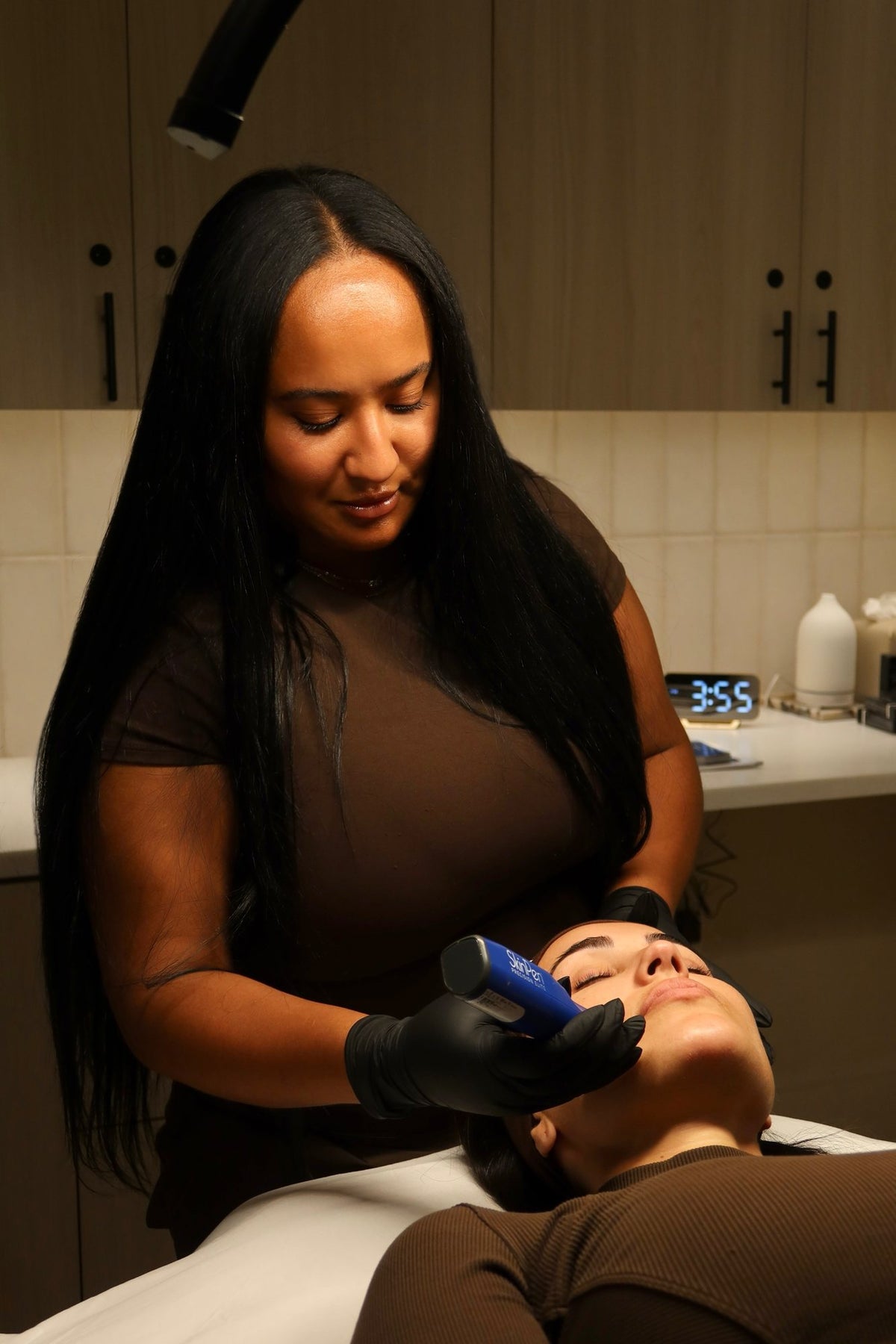
What SkinPen Microneedling Is
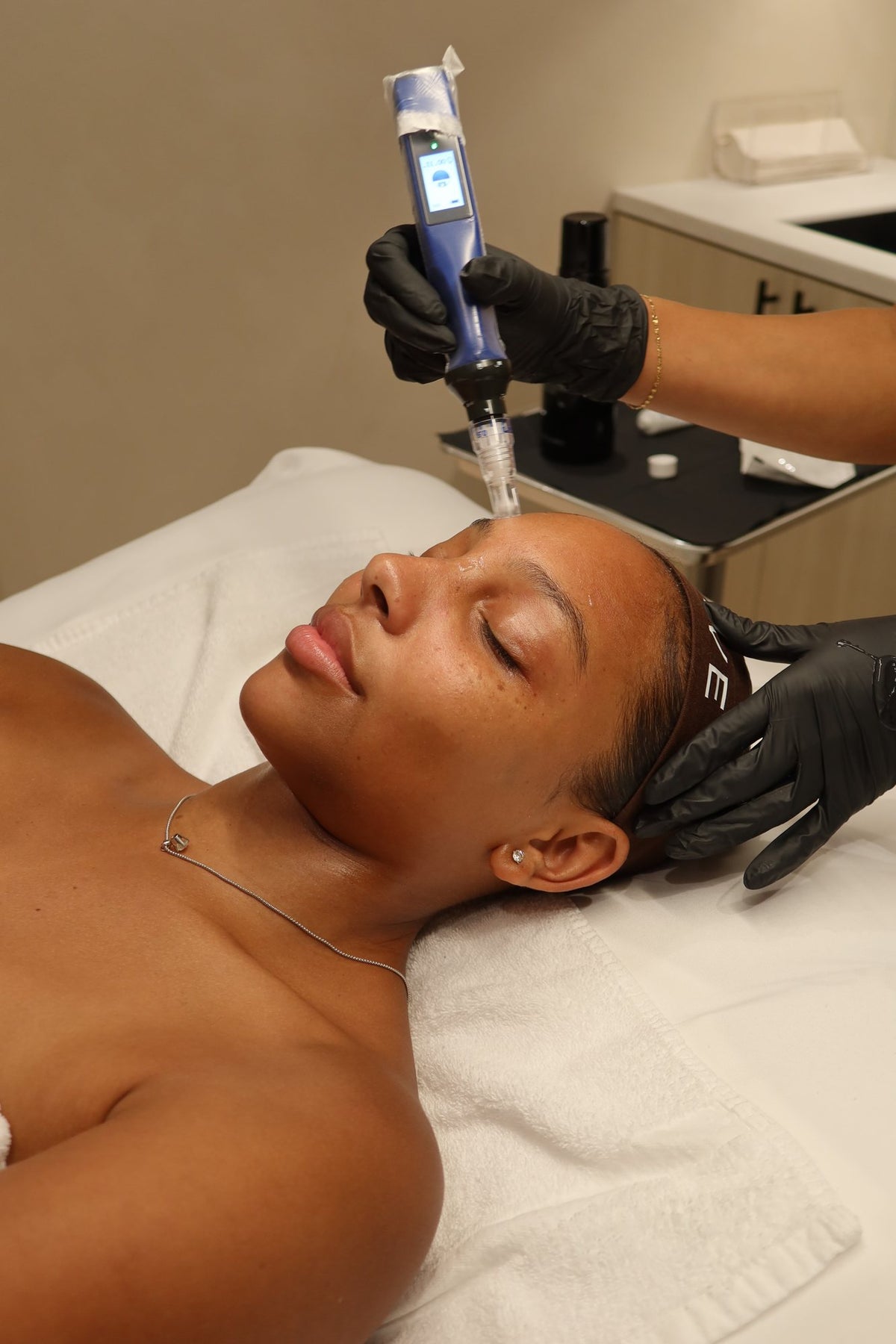
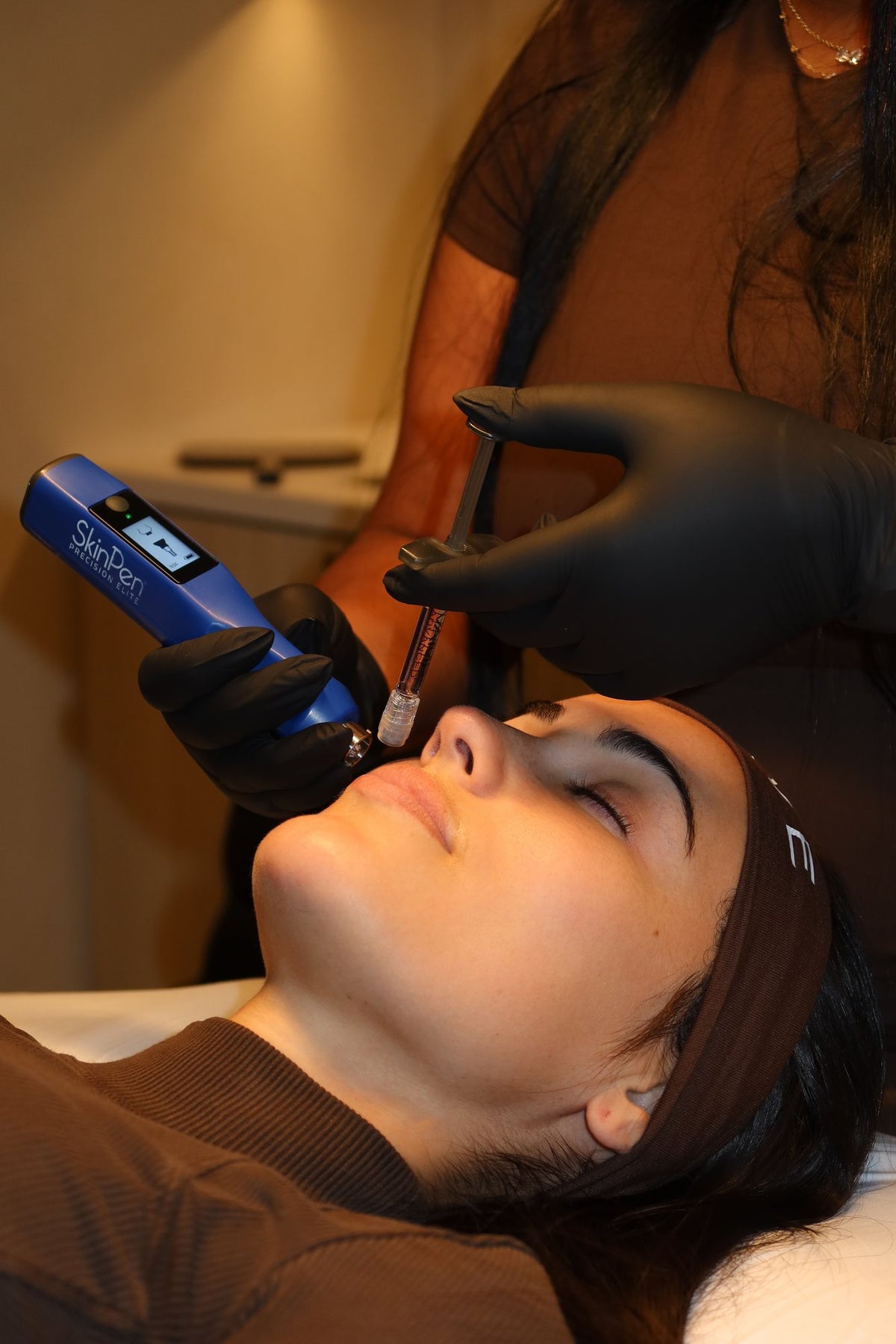
SkinPen is a brand of automated microneedling device. The generic category is collagen induction therapy: a motorized handpiece drives an array of fine, sterile needles into the skin at a controlled depth, creating thousands of microscopic channels that provoke a healing response. The needles are the tool; the collagen your body lays down afterward is the treatment.
The regulatory detail is worth stating precisely, because it is routinely inflated in marketing. SkinPen was the first microneedling device to receive FDA clearance, and that clearance is narrow: treatment of facial acne scars in adults aged 22 and older. It is not a blanket clearance for wrinkles, pores, tone, or body skin. Those uses are widespread and well documented, but they sit outside the cleared indication.
An automated pen also differs from the at-home dermaroller it is often confused with. Its needles oscillate vertically at high speed, entering and exiting along the same axis to produce uniform channels. A roller drags its needles in at one angle and out at another, tearing the epidermis rather than perforating it cleanly. Depth is adjustable on a pen, roughly a quarter of a millimeter to two and a half millimeters, and the cartridge is sterile and single-use.
How It Works
Microneedling works by injuring the skin on purpose, in a controlled and survivable way. Each pass creates a column of micro-trauma that crosses the epidermis and reaches into the dermis without removing tissue the way a laser does. The surrounding skin stays intact, which is why healing is fast: undamaged cells sit immediately beside every channel and repopulate it quickly.
What follows is the wound-healing cascade, in three overlapping phases. Inflammation comes first, over roughly a day or two, as platelets arrive and growth factors are released. Proliferation follows over the next weeks, with fibroblasts migrating into the channels and depositing fast, disorganized Type III collagen. Remodeling is the long phase and the one that matters: over months, that Type III collagen is replaced by stronger, better-organized Type I collagen, with new elastin laid down alongside it.
That timeline explains how the treatment is used. The change is genuinely structural but slow, so one session produces a modest real improvement and a series produces a cumulative one. Each session adds stimulus while the previous round is still remodeling, which is why three to six sessions spaced weeks apart consistently outperform one deep session.
Depth is the main variable your provider controls, and it is set by area rather than preference. Thin skin around the eyes and forehead is treated shallowly. Cheeks tolerate more, and acne scarring is treated at the deeper end because the target tissue sits deep. Neck, chest, and hands are treated conservatively. Deeper is not better; it is the route to most of the complications on this page.

What SkinPen Microneedling Treats
Atrophic acne scarring
The indication SkinPen was actually cleared for. Rolling and shallow boxcar scars respond best, because the mechanism rebuilds the dermal collagen that was lost. Narrow ice-pick scars respond least and often need an additional approach.
Rough or uneven skin texture
Diffuse roughness from sun exposure and years of turnover improves as the dermis is remodeled and the epidermis rebuilds more evenly. Usually the first change people notice.
Pores that look enlarged
Thickening the dermal support around a follicle tightens how the opening reads. Pore size itself is genetic and does not change, but a pore held in firmer tissue looks smaller.
Fine lines and crepey skin
New collagen and elastin add thickness and spring, softening fine lines and crepiness. It does not address dynamic expression lines caused by muscle movement, which are a neuromodulator's job.
Early laxity and thin skin quality
Microneedling improves skin quality rather than lifting sagging tissue. Expect firmer, denser skin, not a change in facial contour.
Post-inflammatory erythema and uneven tone
The flat pink or red marks left behind after acne clears often fade as the skin rebuilds. Gradual and cumulative rather than immediate.
Surgical and traumatic scars
Mature, flat or slightly depressed scars can be softened and blended. Timing matters, and a keloid or hypertrophic scarring history changes the conversation entirely.
Stretch marks and body skin
Widely used off-label on the abdomen, thighs, chest, and neck. Off-label does not mean improper, but the use was not part of the device clearance, and body skin heals more slowly than the face.
Is SkinPen Microneedling Right For You?
You May Be A Good Candidate If
- Your leading concern is texture, atrophic acne scarring, enlarged-looking pores, or thin, crepey skin rather than volume loss or significant sagging.
- You have any Fitzpatrick skin type. Because the mechanism is mechanical rather than light-based, microneedling is generally considered safer in deeper skin tones than ablative and many non-ablative lasers.
- You are willing to commit to a series and to wait, since the visible payoff arrives across months.
- You heal normally, have no active infection or inflammatory flare in the area, and are not immunosuppressed.
- You will actually wear sunscreen daily. It is the single largest factor in whether you finish a series with brighter skin or with new pigmentation.
- You want a treatment that reads as your skin looking better rather than your face looking different.
This May Not Be Right For You If
- You have active inflammatory or cystic acne, pustules, or open lesions in the area. Needling through active acne can spread bacteria and drive inflammation, and it is a recognized route to worse scarring. Control the acne first, then treat the scars.
- You are taking isotretinoin, or finished a course recently. Skin on isotretinoin heals abnormally, and a six-month wait was long the standard. Newer evidence suggests shorter intervals may sometimes be acceptable, but the timing is a medical judgment, not a preference.
- You have a history of keloid or hypertrophic scarring. A treatment that works by triggering healing is the wrong thing to offer skin that already overshoots healing.
- You are pregnant or breastfeeding. Microneedling is elective and typically deferred, and some numbing agents and topicals used alongside it are avoided in pregnancy.
- You have an active herpes simplex outbreak, cold sore, warts, or any active bacterial or fungal skin infection in the area.
- You are in an eczema, psoriasis, or rosacea flare in the area, or the skin is sunburned, broken, or otherwise not intact.
- You have a bleeding disorder or take anticoagulants. Never stop a prescribed medication without clearing it with the prescriber.
- You are on chemotherapy, have had radiotherapy to the area, have poorly controlled diabetes, or have any condition that impairs wound healing.
- You have an undiagnosed lesion or suspicious mole in the area. That needs a diagnosis before anything cosmetic.
The honest framing: microneedling is one of the better value propositions in aesthetics for texture and atrophic scarring, and also one of the most oversold. Across a series it will meaningfully soften rolling acne scars, refine texture, and thicken thin skin. It will not lift sagging tissue, replace lost volume, or match a fractional CO2 laser for severe scarring. Two failure modes cause most disappointment. The first is expectation: judging the result at week two instead of month four. The second is technique, since nearly every serious complication below comes from treating too deep, too aggressively, or over skin that should not have been treated at all.
How SkinPen Microneedling Compares
Microneedling sits in a crowded middle ground, and the treatments around it are genuinely different tools rather than competing brands. Two variables separate them: how deep they reach, and whether they use heat or light energy to get there. Depth determines how much they can remodel; energy determines how much recovery and pigment risk they carry.
| Feature | Microneedling (SkinPen) | Microneedling with RF | Fractional CO2 laser | Chemical peel |
|---|---|---|---|---|
| How it works | Sterile needles create microchannels; the wound-healing cascade builds new collagen and elastin. Mechanical only, no heat or light | The same needles also deliver radiofrequency energy from their tips, adding controlled heat in the dermis | A fractionated laser beam vaporizes columns of tissue, leaving untreated skin between them to drive healing | An acid solution dissolves the bonds between cells, causing controlled exfoliation or a deeper wound |
| What it reaches | Epidermis into the dermis, at a depth set by area | Deeper dermis, with a thermal effect beyond the needle track | Epidermis and dermis, with tissue actually removed | Superficial to deep, depending on the agent and concentration |
| Tightening effect | Gradual firming from new collagen; no immediate contraction | Greater, since heat contracts collagen immediately as well as stimulating more | Strongest of the four for significant laxity and severe scarring | Minimal; peels work mainly on tone and surface texture |
| Risk in deeper skin tones | Lowest here. With no light or heat, the main risk is hyperpigmentation from overly aggressive treatment | Low and generally considered safe across skin types, though heat raises pigment risk above needling alone | Highest. Real risk of both hyper- and hypopigmentation in deeper tones | Variable and agent-dependent; deeper peels carry meaningful pigment risk |
| Typical recovery | Flushed for one to two days, dry or rough for a few more | Redness and swelling for two to four days | Roughly one to two weeks of swelling, crusting, and peeling | None for a superficial peel; days to weeks for a deeper one |
| Typical course | Three to six sessions, four to six weeks apart | A shorter series, commonly around three sessions | Often a single treatment, occasionally repeated | A series for superficial peels; one treatment for deeper ones |
| Best suited to | Texture, atrophic acne scarring, pores, and thin or crepey skin, at any skin tone | The same concerns plus early laxity, where tightening is wanted | Severe scarring, deep wrinkles, and marked photodamage, when downtime is acceptable | Tone, dullness, pigmentation, and surface texture |
| Main limitation | Slow and cumulative; will not lift sagging tissue or replace lost volume | Heat adds cost, discomfort, and a small risk of fat loss if overdone | Significant downtime and the highest complication profile of the four | Works largely at the surface, so it remodels the dermis far less |
The most useful comparison is not on this table, because a resurfacing facial is not really an alternative. A DiamondGlow facial exfoliates, extracts, and infuses at the surface, with no downtime and no dermal remodeling. Microneedling reaches the dermis and rebuilds it. That is the real distinction: one makes your skin look its best now, the other changes what your skin is made of. They sequence well, spaced apart.
What To Expect
Before The Treatment
- Consultation and skin assessment. Your provider confirms microneedling suits your concern, reviews your history, checks the contraindications above, and sets depth by area. Photographs are usually taken, because gradual change is hard to judge from memory.
- Stop retinoids, retinol, and exfoliating acids in the area for several days beforehand, and skip scrubs and at-home devices. Stacking exfoliation onto needling is the most common cause of an over-irritated result.
- Avoid waxing, depilatory creams, and laser hair removal in the area for about a week, and do not arrive with a fresh sunburn or self-tan.
- Disclose any history of cold sores. Facial trauma is a recognized trigger for HSV reactivation, and prophylactic antivirals are often discussed in advance.
- Where medically appropriate, you may be asked to pause non-essential blood-thinning supplements and anti-inflammatory medications for a few days. Prescribed medications are only ever changed by the prescriber.
- Arrive with clean skin, and with nothing that evening you would mind attending looking flushed.
Results: Onset And How Long It Lasts
Most people notice smoother texture and a brighter tone within one to two weeks of the first session. The structural change is slower: new collagen keeps remodeling for three to six months after the final treatment, so the honest assessment point is months out. Results are cumulative across a series and, with sun protection and maintenance, durable.
During The Treatment
- The skin is cleansed and thoroughly disinfected. Sterility matters more here than in most aesthetic treatments, since thousands of channels are about to be opened into the dermis.
- Topical numbing cream is applied and left to work, usually twenty to thirty minutes. Most of the appointment is this step.
- The cream is removed, the skin cleansed again, and a sterile single-use cartridge fitted to the handpiece with the depth set for the first zone.
- Your provider works in sections with overlapping passes, adjusting depth between areas: shallower on the forehead and around the eyes, deeper on the cheeks and over scarring, conservative on the neck and chest.
- Pinpoint bleeding and a wet sheen are normal at working depths. A sterile gliding serum, typically hyaluronic acid, keeps the needles from dragging.
- Only agents suitable for intradermal exposure go on afterward. This is not the moment for a vitamin C serum or anything fragranced; unsuitable topicals on needled skin are a recognized cause of granulomatous reactions.
- A calming finish and mineral sunscreen close the appointment. Face-only treatment time is usually twenty to thirty minutes, so expect around an hour including numbing.
How Often, And Why
Microneedling is a series treatment, and the spacing is not arbitrary. A common course is three to six sessions four to six weeks apart, which lets one round of collagen remodeling get underway before the next stimulus is added. Textural concerns often respond within three sessions. Atrophic acne scarring generally needs more, and it is the concern most likely to require patience across several months. The neck and body are typically spaced further apart, because skin there heals more slowly.
After the series, maintenance is light. Many people return two to four times a year to keep pace with the collagen loss that continues with age regardless. Because remodeling runs for three to six months after the final session, results are assessed at that point rather than immediately, and further sessions are better decided then. Your provider will also sequence microneedling around peels, lasers, injectables, and strong at-home retinoids, which need spacing rather than stacking.
Afterward
- Expect to look sunburned for the rest of the day. Redness peaks in the first few hours and usually fades substantially within twenty-four to forty-eight hours.
- Leave the skin alone on day one: no makeup, no actives, no touching. Lukewarm water and clean hands only, then a gentle cleanser from the next morning.
- Broad-spectrum SPF 30 or higher daily, without exception, and stay out of direct sun while healing. Sun on freshly needled skin is the fastest route to post-inflammatory hyperpigmentation, and this matters most in deeper skin tones.
- Skip strenuous exercise, saunas, steam rooms, hot tubs, pools, and hot showers for about forty-eight hours. Sweat, heat, and chlorine on open microchannels are avoidable irritants and an infection risk.
- Keep the routine minimal for about five days: gentle cleanser, bland moisturizer, sunscreen. Reintroduce retinoids and acids only when your provider says so, usually after five to seven days.
- Expect dryness, tightness, and a fine sandpaper roughness across days two to five, sometimes with light flaking. Moisturize; do not exfoliate or pick.
- Avoid facials, peels, waxing, and other treatments in the area for a couple of weeks, and book the next session. Finishing the series is what produces the result you came for.

How Much Does SkinPen Microneedling Cost in Atlanta, GA?
- What it is priced by: Per session
- Typical cost: From $400 / session
The figure above is a starting point, not a quote. What you pay depends on how much product your anatomy actually needs, which is a clinical judgement made in person. Ask at your consultation.
Side Effects And Downtime
Common And Expected
- Redness resembling a moderate sunburn, most intense on day one and typically settling within one to two days.
- Mild swelling, especially around the eyes and forehead, usually peaking the following morning.
- Pinpoint bleeding during treatment, and occasional tiny scabs or bruising afterward, more likely at deeper settings.
- Dryness, tightness, and a fine rough texture across days two to five, sometimes with light flaking.
- Temporary sensitivity to actives and to sun for the first several days.
- Occasional small breakouts in the days after treatment, particularly in congestion-prone skin.
When To Seek Care
- Spreading redness, increasing warmth, pus or drainage, significant pain, or fever, which can indicate infection and needs prompt evaluation.
- A cold-sore outbreak in the days after treatment, since antivirals work far better started early.
- Blistering, weeping, an open wound, or any area that looks like it is breaking down rather than healing.
- Redness, swelling, or pain that worsens after the first forty-eight hours instead of settling.
- New darkening of the treated skin, which is easier to manage before it establishes.
- Hives, a spreading rash, facial swelling, or any difficulty breathing, which warrants emergency care.
Less Common, But Important To Know
- Post-inflammatory hyperpigmentation, the most important risk to understand in deeper skin tones. Skin that pigments readily can respond to excessive inflammation by darkening. The drivers are treating too deep, too aggressively, too often, or without strict sun protection afterward. It is usually temporary but can take months to fade, and conservative depth plus disciplined sunscreen is the whole prevention strategy.
- Tram-track scarring, meaning fine linear marks following the path of the pen. This is a technique complication rather than a treatment risk: it comes from dragging the handpiece across the skin instead of lifting between passes, or from working too deep.
- Reactivation of herpes simplex, since needling is a recognized trigger in people prone to cold sores. Disclose a cold-sore history so prophylactic antivirals can be considered.
- Bacterial infection or folliculitis, which is why sterile single-use cartridges, thorough disinfection, and keeping sweat and pools away for a couple of days all matter.
- Granulomatous or allergic reactions to a topical applied during or right after treatment, the documented reason not to put arbitrary serums on needled skin.
- Milia, small white cysts in the treated area, which usually resolve or can be extracted.
- Prolonged redness or swelling beyond several days, which warrants a call rather than waiting it out.
- Worsened acne or new scarring if treatment was performed over active inflammatory acne, which is why that is a contraindication rather than a caution.
Downtime
Plan on one to two days of looking noticeably flushed, then several days of dry, slightly rough skin that makeup covers reasonably well from about day two. That is the realistic window: shorter than a laser, longer than a facial. Treating late in the week and being socially comfortable by the weekend is a common pattern, though skin is still healing beneath the surface for longer than it looks. The hard constraints protect the result rather than your calendar: no sun, no sweat, no heat, and nothing active on the skin for the first couple of days.
Who Performs This Treatment

Brianna Harris
Aesthetician · Facials, peels, microneedling and resurfacingBrianna is one of Alcove's aestheticians. Every treatment starts with a look at your skin and what you want from it, and your plan, including what you use at home, is built from there.

Shaina Paul
Aesthetician · Facials, peels, microneedling and resurfacingShaina is Alcove's aesthetician. Every treatment starts with a look at your skin and what you want from it, and your plan, including what you use at home, is built from there.
SkinPen Microneedling FAQs
Less than people expect, because topical numbing cream is applied and given twenty to thirty minutes to work. Most people describe a vibrating, sandpapery pressure that is uncomfortable rather than painful. Bonier areas such as the forehead, hairline, and jaw are the most sensitive, and deeper settings over acne scarring feel sharper than a shallow pass.
Usually three to six, spaced four to six weeks apart. It is genuinely a series rather than a one-off. Texture and tone often improve within three sessions, while atrophic acne scarring typically needs more, because you are rebuilding dermal collagen that was lost. Your provider sets the number based on how your skin responds along the way.
Expect to look sunburned for one to two days, then dry and slightly rough for several more, with makeup usually workable from about day two. It is meaningfully shorter than a fractional CO2 laser and longer than a facial. Sun, sweat, and heat are off the table for roughly forty-eight hours.
It is generally considered one of the safer resurfacing options across all Fitzpatrick types, because the injury is mechanical rather than light or heat energy, so pigment-producing cells are not targeted by a wavelength. The risk is lower, not absent: post-inflammatory hyperpigmentation can still follow treatment that is too deep or too aggressive, or poor sun protection afterward.
Both create the same microchannels. RF microneedling additionally delivers radiofrequency energy from the needle tips, adding controlled heat in the dermis. That heat contracts existing collagen immediately and stimulates more, so it gives a stronger tightening effect and suits early laxity better. It also costs more, is less comfortable, and carries a longer recovery.
It can meaningfully improve them, which is different from removing them. Treating facial acne scars in adults 22 and older is the indication SkinPen was FDA-cleared for, and rolling and shallow boxcar scars respond best because the mechanism rebuilds lost dermal collagen. Narrow ice-pick scars respond least. Expect substantial softening across a series, not erasure.
No, not over active inflammatory or cystic acne, pustules, or open lesions. Needling through active acne can spread bacteria across the treated area and worsen inflammation, and it is a recognized route to more scarring rather than less. The sequence is to get the acne medically controlled first, then treat the scarring it left behind.
Early textural improvement and a brighter tone usually show within one to two weeks. The structural change builds far more slowly, because collagen remodeling continues for three to six months after your final session. Judging the result at week two is the most common reason people conclude it did not work. Baseline photographs help enormously here.
No, and the difference matters. An automated pen drives needles in and out along the same vertical axis at a controlled depth, producing clean channels with a sterile single-use cartridge. A roller drags needles in at one angle and out at another, tearing the epidermis, and a reused roller adds infection risk. Home devices are also deliberately too shallow to remodel the dermis.
They solve different problems. A resurfacing facial such as DiamondGlow exfoliates, extracts, and infuses at the surface, with no downtime and no effect on collagen. Microneedling reaches the dermis and rebuilds it, with a few days of recovery as the price. Choose the facial for immediate glow and congestion, microneedling for texture, scarring, and skin quality.
Not while taking it, and the interval afterward is a medical decision rather than a preference. Skin on isotretinoin heals abnormally, and a six-month wait was long the standard recommendation. Newer evidence suggests shorter intervals may sometimes be acceptable, so disclose current or recent use and let your provider set the timing.
Yes, and combination protocols are common, because fresh microchannels let suitable agents reach past the skin barrier. Platelet-rich plasma is the best-known pairing, using growth factors drawn from your own blood. The important limit is that only agents appropriate for intradermal exposure belong on needled skin, since unsuitable topicals are a documented cause of granulomatous reactions.
Pairs Well With




Book Your Consultation
A consultation is a conversation about your face, not a sales appointment. Bring your questions about SkinPen Microneedling and your medical history, and leave with an honest answer about whether it is the right treatment for you.