



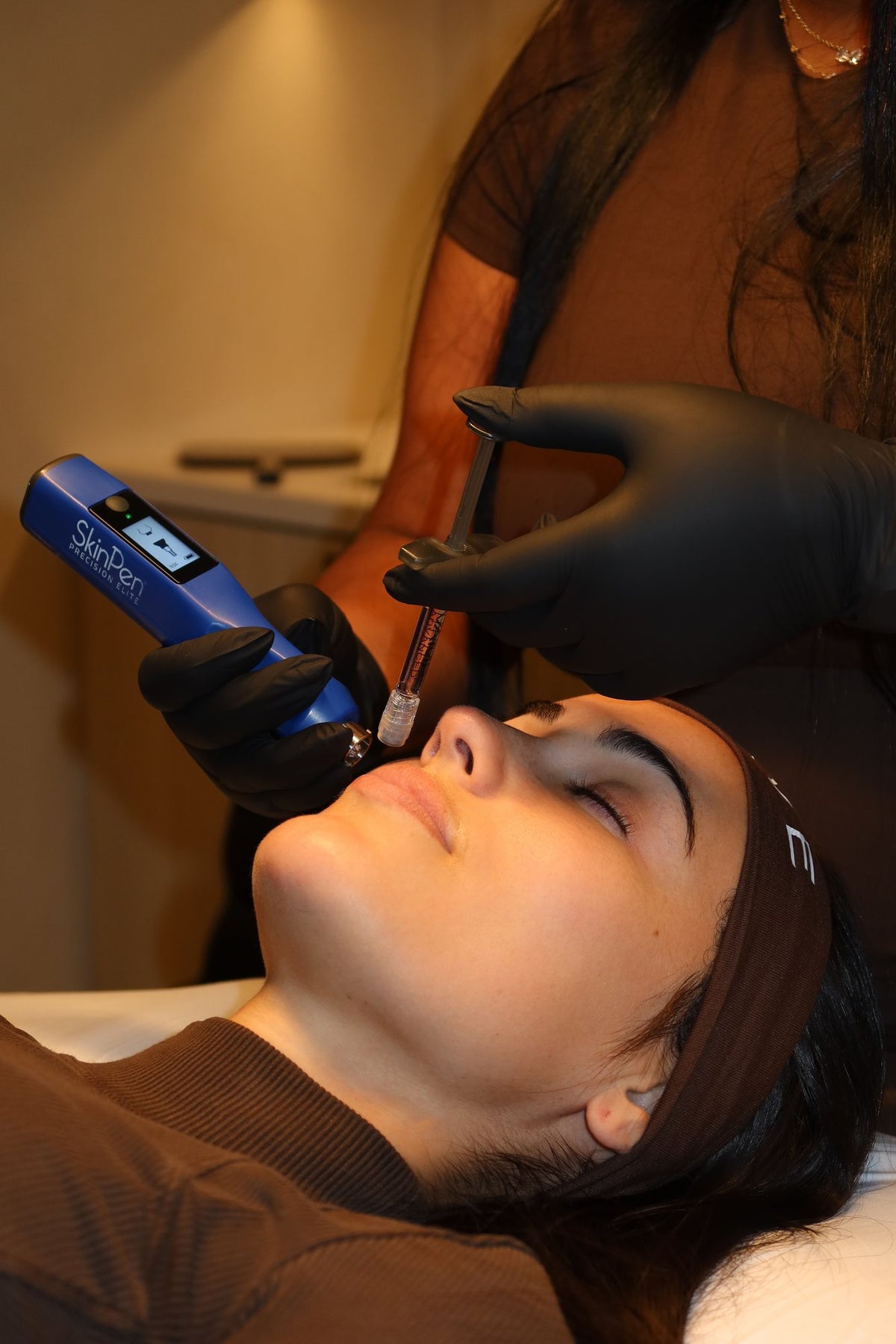
Microneedling with PRP in Atlanta, GA
Microneedling works by convincing the skin it has been injured, then letting the repair response do something useful. Adding platelet-rich plasma is an attempt to make that repair response louder — supplying concentrated growth factors from your own blood into the channels the needles have just opened. It is one appointment doing two things, and it is most often chosen by people dealing with texture and acne scarring rather than by people chasing a glow.
The Benefits
Two Signals At Once
Two mechanisms in one appointment: the needling creates the injury signal that drives collagen remodeling, and the plasma adds concentrated growth-factor signaling into it.
Your Own Blood
The plasma is made entirely from your own blood, so there is no donor material, no synthetic implant, and no possibility of reacting to a foreign substance.
Channels That Carry It
The micro-channels created by needling give large growth-factor proteins a route past a skin barrier that would otherwise exclude them almost entirely.
Built For Scarring
Atrophic acne scarring is the indication this combination is most associated with, where needling supplies the remodeling stimulus and the plasma supplies additional repair signaling.
Nothing Synthetic
Nothing manufactured is introduced — no filler, no implant, no permanent material — so there is nothing that can migrate, need dissolving, or persist unexpectedly.
One Appointment
It is delivered in a single appointment rather than as two separate procedures with two separate recoveries.
Cumulative By Design
Change accrues gradually across a course of treatment as new collagen matures, which suits anyone who does not want a visible before-and-after moment.
Ask About Handling
Because a blood product is involved, it invites scrutiny of a practice's sterile technique and handling — and a clear answer to those questions tells you something worth knowing.
Real Results
Before & After
 After
After Before
 After
After Before
 After
After Before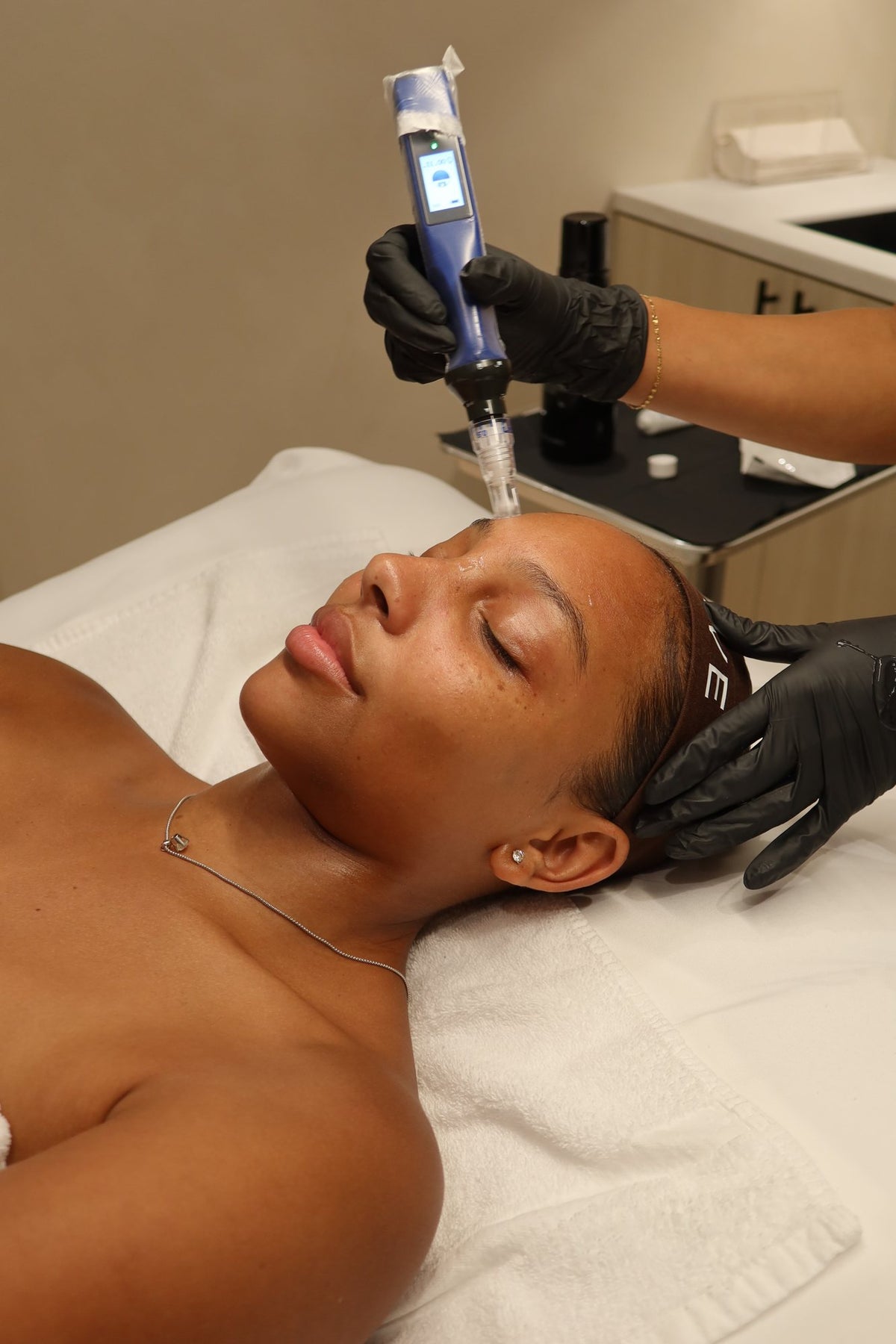
What Microneedling with PRP Is
This treatment combines two procedures performed in the same appointment. Microneedling uses a device with fine, sterile needles to create thousands of controlled micro-injuries in the skin at a set depth. Those punctures are deliberate: the skin's wound-healing response to them is what drives new collagen production and remodels the dermis. This is why the technique is also called collagen induction therapy, and why the depth setting matters — treating superficially addresses surface texture, while treating deeper is required to influence scarring.
Platelet-rich plasma is a concentrate prepared from a small sample of your own blood, drawn at the visit and spun in a centrifuge to separate it by density. The platelet-enriched plasma fraction is drawn off and used. Platelets carry alpha granules packed with signaling proteins — platelet-derived growth factor, transforming growth factor beta, vascular endothelial growth factor, epidermal growth factor, and others — that coordinate the body's repair response at a site of injury.
The rationale for combining them is delivery. Growth factors are large proteins, and intact skin excludes molecules that size very effectively. The micro-channels created by needling remain open for a limited period, and applying the plasma preparation during that window is what gives it a route past the barrier. In some protocols the plasma is also injected into the dermis alongside the topical application. The needling supplies the injury signal; the plasma supplies additional signaling into it.
The colloquial name for this combination is the vampire facial. It is memorable and it tells you nothing clinically useful — it describes the appearance of the treatment rather than what it does. What matters more is that PRP is not FDA-approved for aesthetic use. The centrifuge systems that prepare it are cleared as devices, and microneedling devices are cleared for defined indications, but the combination as an aesthetic treatment is off-label. Published results vary with preparation method, needle depth, and protocol, which is a real limitation rather than a footnote.
How It Works
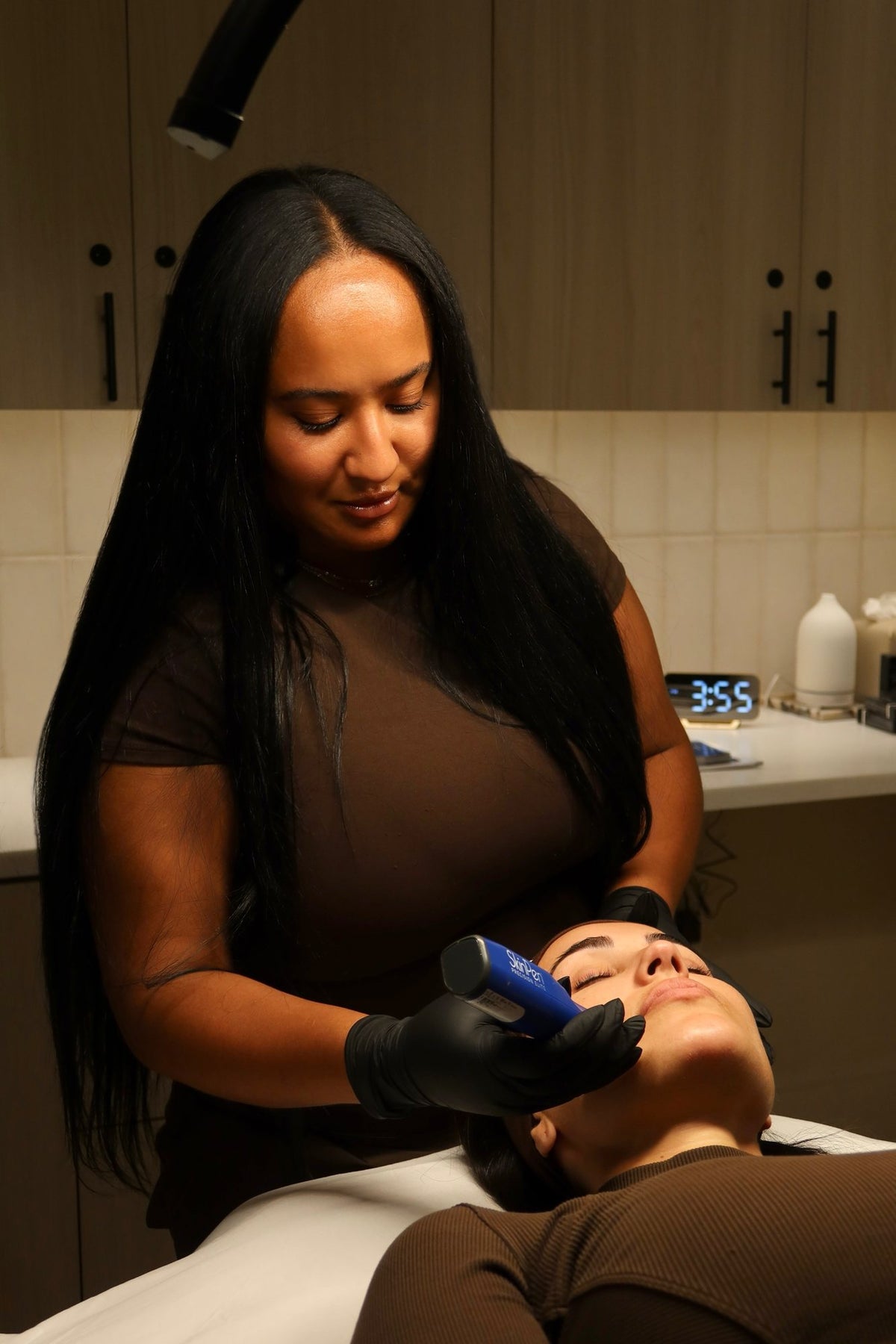
The needling device passes over the skin with fine needles oscillating at a set depth, creating thousands of narrow columns of controlled injury. Each puncture closes quickly, but the tissue registers the damage and initiates the wound-healing cascade: an inflammatory phase in which platelets and immune cells arrive at the site, a proliferative phase in which fibroblasts multiply and lay down new collagen and extracellular matrix, and a long remodeling phase in which that new tissue is reorganized and strengthened. That remodeling is what improves texture and softens the appearance of scarring, and it unfolds across months rather than days.
The plasma is prepared while numbing cream is working. Blood is drawn from the arm, spun in a centrifuge, and the platelet-rich fraction separated off. Platelets in that fraction, once released into tissue and activated, degranulate and release their stored growth factors. Those proteins are not building material — they are instructions. They bind receptors on fibroblasts, endothelial cells, and resident stem cell populations and prompt proliferation, collagen synthesis, and angiogenesis, the formation of the small vessels that supply healing tissue.
The combination depends on timing. Micro-channels created by needling stay open for a limited window, commonly described in hours rather than days, and that is when a large protein has a route past the stratum corneum. Applying the plasma during and immediately after the needling pass is what gets it to a depth where fibroblasts can respond to it. Applied to intact skin later, the same preparation delivers considerably less.
The same open-channel effect imposes a constraint. Anything on the skin during that window reaches deeper than it otherwise would, which is why providers are specific about what may be applied afterward and why resuming ordinary skincare early is a genuine problem rather than a minor deviation. It is also why sterile technique matters here more than in a treatment that leaves the barrier intact — and, with a blood product involved, why it is fair to ask exactly how the sample is labeled, handled, and disposed of.

What Microneedling with PRP Treats
Atrophic acne scarring
The strongest indication for this combination. Rolling and boxcar scars respond best; ice-pick scars generally need a different technique. Treatment is a series with the goal of improvement rather than resolution.
Uneven skin texture and enlarged-looking pores
Needling remodels the surface and the upper dermis, which is what changes the way light falls across textured skin. Pores are not closed by any treatment, but the surrounding tissue can be tightened.
Fine lines and early skin laxity
Superficial lines associated with declining dermal collagen are a reasonable target. Deep static folds and lines driven by muscle movement are different problems needing different treatments.
Dull, tired-looking skin
Improved texture and light reflection is what patients most consistently describe after a course, though the first week is healing rather than improvement.
Post-inflammatory textural change
Skin left rough or uneven after acne or another inflammatory process. Pigment left behind is a separate problem and often needs a different modality alongside this one.
Stretch marks and scarring elsewhere on the body
The same principle is applied off the face, though body skin heals more slowly and typically needs more sessions for less change. Expectations should be set accordingly.
Skin quality in people avoiding synthetic products
Because the plasma is entirely autologous and the needling introduces nothing, the whole treatment involves no manufactured material — which matters to some people and is a genuine feature rather than a talking point.
Skin preparing for or recovering from other treatments
Sometimes sequenced with resurfacing, biostimulators, or injectables as part of a broader plan. The ordering and spacing matter and are planned at consultation rather than assembled piecemeal.
Is Microneedling with PRP Right For You?
You May Be A Good Candidate If
- Adults with atrophic acne scarring — particularly rolling and boxcar scars — who understand that a series is required and that improvement rather than resolution is the goal.
- People with uneven texture, early laxity, or fine lines who want a treatment aimed at skin quality rather than volume or contour.
- People who prefer an approach built from their own biological material over anything manufactured.
- People able to commit to a course of sessions spaced several weeks apart, and to maintenance afterward.
- People who can plan around visible recovery — redness for a day or two, then dryness and flaking — rather than treating immediately before an event.
- People in generally good health with a normal platelet count and no bleeding or clotting disorder, as determined at a medical evaluation.
- People with realistic expectations about pace. Nothing meaningful is visible in the first week, and the change that matters develops across months.
- People willing to ask direct questions about how the blood sample is drawn, labeled, handled, and disposed of.
This May Not Be Right For You If
- Anyone with active acne, particularly inflammatory or cystic lesions, in the treatment area. Needling through active acne can spread bacteria and worsen the condition; the acne is treated first.
- Anyone with an active skin infection, an open lesion, or an active herpes simplex outbreak in the area, until it has resolved.
- Anyone with a history of keloid or hypertrophic scarring, where controlled injury to the skin carries a real risk of producing exactly the outcome you are trying to treat.
- Anyone with a platelet disorder, thrombocytopenia, a bleeding or clotting disorder, or diagnosed platelet dysfunction, since the plasma component depends on healthy platelets.
- Anyone with a hematologic malignancy, or a history of one, without clearance from their treating physician.
- Anyone on anticoagulant or antiplatelet therapy that cannot be safely paused — a decision belonging to the prescribing clinician alone.
- Anyone currently taking isotretinoin, or who has recently finished a course, where the timing of any needling procedure must be discussed with the prescribing clinician.
- Anyone with an active inflammatory or autoimmune skin condition affecting the area — active eczema, psoriasis, or rosacea in flare — until it is controlled.
- Anyone with a chronic liver condition, severe anemia, sepsis, or an acute or chronic blood-borne infection, where blood-derived treatment requires specialist input.
- Anyone who is pregnant or breastfeeding, since elective procedures are generally deferred and safety data in this context is absent.
- Anyone with a skin cancer or undiagnosed lesion in the treatment area.
- Anyone expecting volume restoration, lift, or a change in facial shape. This treatment does none of those things.
Because this treatment involves both a broken skin barrier and a blood product, the questions worth asking are more specific than for most aesthetic procedures. Ask whether the needling cartridge is single-use and opened in front of you, how the blood sample is labeled, whether it ever leaves the treatment room, and how equipment and waste are handled. A well-run practice answers all of that without hesitation. A licensed provider should also take a full medical history, ask specifically about bleeding disorders, blood-borne infection, keloid tendency, isotretinoin use, and cold sores, and assess your scar type — because not all acne scarring responds to needling, and knowing which kind you have changes the plan.
How Microneedling with PRP Compares
Microneedling appears in several forms, and the differences between them are often blurred in marketing. The table sets out what adding PRP actually changes relative to the alternatives.
| Feature | Microneedling + PRP | Microneedling alone | Microneedling + growth-factor topical | Fractional resurfacing laser |
|---|---|---|---|---|
| The stimulus | Controlled micro-injury from fine needles | Controlled micro-injury from fine needles | Controlled micro-injury from fine needles | Controlled thermal injury in fractionated columns |
| What is added | A concentrate of your own platelets, applied and sometimes injected | Nothing | A manufactured topical containing growth factors | Nothing; the energy itself does the work |
| Source of the added material | Autologous — your own blood, drawn at the visit | Not applicable | Manufactured; source and concentration vary by product | Not applicable |
| Allergy consideration | None to the plasma itself | None | Possible, to components of the formulation | None |
| Appointment length | Longer — includes a blood draw and centrifuge time | Shorter | Similar to needling alone | Varies by device and area |
| Typical downtime | Redness for a day or two, then dryness and flaking | Redness for a day or two, then dryness and flaking | Redness for a day or two, then dryness and flaking | Longer and more pronounced, depending on depth and device |
| Best-associated indication | Atrophic acne scarring and textural remodeling | Texture, early laxity, and scarring | General skin quality as an adjunct | Deeper resurfacing, significant photodamage, and scarring |
| Regulatory status | Devices are FDA-cleared; PRP for aesthetic use is off-label | Specific devices are FDA-cleared for defined indications | Devices cleared; topicals generally marketed as cosmetics | Specific devices are FDA-cleared for defined indications |
Which of these is appropriate depends on what you are treating, your skin type, your tolerance for downtime, and — for scarring — the specific scar morphology, which needs to be assessed in person. These approaches are also often sequenced rather than chosen between across a longer plan. That sequencing is a clinical judgment made at consultation, not a decision to make from a table.
What To Expect
Before The Treatment
- A consultation and skin assessment, including scar type where scarring is the concern, since not all acne scarring responds to needling and the answer changes the plan.
- A full medical history and review of all medications and supplements, with specific questions about bleeding disorders, anticoagulants, blood-borne infection, keloid tendency, cold sores, isotretinoin use, and pregnancy.
- A discussion of what the combination can and cannot do, including that PRP for aesthetic use is off-label and that results vary with preparation and protocol.
- Instructions to stop retinoids, exfoliating acids, and other active skincare for a period beforehand, and to avoid sun exposure and self-tanner in the run-up.
- Guidance on pausing blood-thinning medications and supplements such as aspirin, non-steroidal anti-inflammatory drugs, fish oil, and vitamin E — but only where your prescribing clinician confirms it is safe. Never stop a prescribed medication on your own.
- A prophylactic antiviral prescription if you have a history of cold sores, since any procedure creating micro-injury can trigger an outbreak.
- Advice to eat beforehand and arrive well hydrated, which makes the blood draw easier and reduces the chance of feeling lightheaded.
- Instructions to arrive with clean skin, free of makeup, sunscreen, and topical products.
Results: Onset And How Long It Lasts
Change from this combination is gradual and cumulative. The first week is recovery rather than improvement: redness, then dryness and light flaking as the surface turns over. Any early brightness is the healing response rather than new collagen. Meaningful change in texture, scar depth, and skin quality develops across the following months as fibroblasts lay down collagen and the dermis remodels, and it is assessed at the end of a series rather than after a single session. For atrophic acne scarring — the indication this combination is most associated with — the realistic goal is meaningful softening of scar depth and improvement in how light falls across the skin, not resolution. Some scar types respond considerably better than others, which is why assessment of scar morphology matters before a plan is made. Response varies between individuals and, because PRP preparation methods and needling depths differ between practices, between protocols. This page publishes no numeric outcome figures: the published literature is inconsistent for exactly those reasons, and averages drawn from it would not tell you anything reliable about your own skin. Skin also continues to age, so maintenance sessions are part of a long-term plan rather than an upsell.
During The Treatment
- A blood draw from the arm, taking a few minutes, using the same technique as routine laboratory work.
- The sample is spun in a centrifuge in the treatment room while topical numbing cream is applied to the face and left in place, typically for around half an hour.
- The platelet-rich fraction is drawn off — a straw-colored liquid, sometimes faintly pink depending on the preparation.
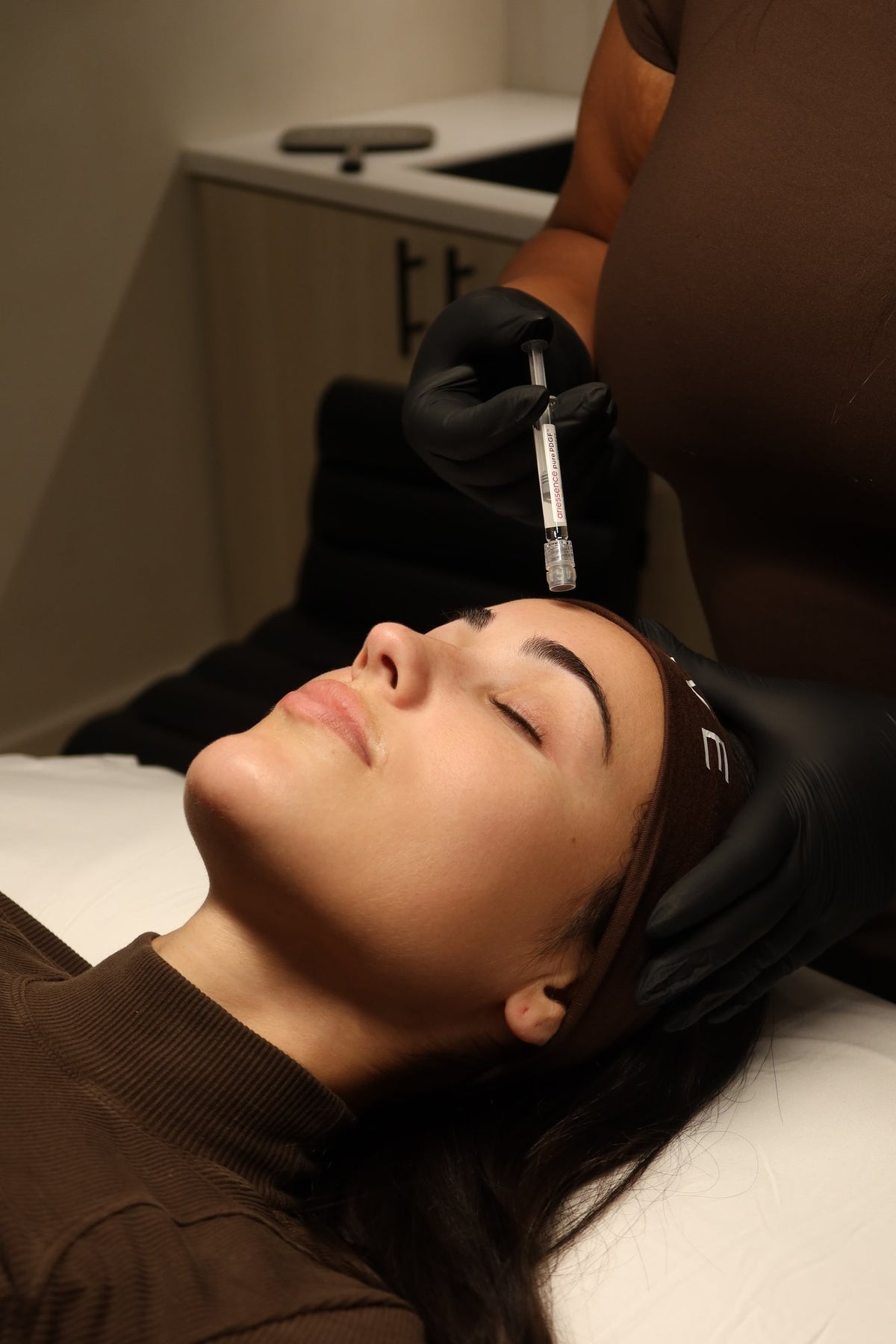
- The needling device is passed across the treatment area at a depth chosen for what is being treated, with the plasma applied to the skin during and immediately after the passes so it enters the channels while they are open.
- Some protocols also inject the plasma into the dermis at specific points, particularly over scarring.
- The sensation is generally described as scratchy and prickly with a vibrating quality, and as more uncomfortable over bony areas such as the forehead and around the nose. Pinpoint bleeding during treatment is expected.
- A session commonly runs around an hour to ninety minutes, most of which is the blood draw, the spin, and the numbing rather than the treatment itself.
- Afterward the skin will be red, warm, and tight — comparable to a moderate sunburn — with the plasma often left in place rather than wiped off.
How Often, And Why
This combination is delivered as a course rather than as a single appointment. A common approach is a series of sessions spaced several weeks apart — often three to six, with scarring generally requiring more than skin quality alone — followed by maintenance at longer intervals. The spacing exists for a reason: collagen remodeling from one session continues for months, and treating again before the skin has completed its response is neither more effective nor safer.
The number of sessions depends primarily on what is being treated. General texture and early laxity typically need fewer sessions than atrophic acne scarring, which is often planned as a longer course with a realistic goal of meaningful improvement rather than resolution. Body areas such as stretch marks generally need more sessions than the face for less change, because body skin heals more slowly.
Maintenance after an initial series is typically at intervals of several months to a year. The improvement is not permanent — skin continues to age, sun exposure continues to accumulate, and collagen continues to decline — so maintenance is intended to hold a gain rather than build a further one.
Where this is sequenced alongside other treatments such as resurfacing, biostimulators, or injectables, spacing matters. Combining procedures too closely can overwhelm the skin's capacity to heal, while sensible sequencing lets each do its job. That planning happens at consultation rather than treatment by treatment.
Afterward
- Expect marked redness and warmth for a day or two, with the skin feeling tight and sensitive. Mild swelling is common, particularly the following morning.
- Leave the skin alone for the first several hours and follow the specific interval your provider gives you before washing. Use lukewarm water and clean hands when you do.
- Avoid makeup for the period specified. Micro-channels remain open for a window afterward and are a route for bacteria.
- Avoid all active skincare — retinoids, exfoliating acids, vitamin C, benzoyl peroxide, and physical scrubs — until your provider clears you. Bland moisturizer and gentle cleanser are what the skin needs.
- Expect dryness, roughness, and light flaking over the following several days as the surface turns over. Do not pick, peel, or exfoliate it; let it shed on its own.
- Avoid strenuous exercise, saunas, steam rooms, hot tubs, and swimming pools for the period you are given. Heat and sweat aggravate freshly treated skin, and pools carry infection risk while channels remain open.
- Protect the area from sun rigorously and use broad-spectrum sunscreen once you are cleared to apply products. Treated skin is more vulnerable to ultraviolet damage and to post-inflammatory pigmentation.
- Sleep on your back for the first night or two where practical, and keep phones and pillows off freshly treated skin.
- Do not judge results early. The first week is healing. Collagen remodeling continues for months, and outcomes are assessed at the end of a series.
- Report anything worsening rather than settling after the first few days — spreading redness, increasing pain, warmth, pus, or fever — promptly.
How Much Does Microneedling with PRP Cost in Atlanta, GA?
- What it is priced by: Per session
- Typical cost: From $750 / session
The figure above is a starting point, not a quote. What you pay depends on how much product your anatomy actually needs, which is a clinical judgement made in person. Ask at your consultation.
Side Effects And Downtime
Common And Expected
- Marked redness and warmth for a day or two, comparable to a moderate sunburn
- Swelling, often most noticeable the morning after treatment
- Tightness, sensitivity, and a rough texture in the treated skin
- Pinpoint bleeding during the procedure and small scabs or dry flaking in the days afterward
- Dryness and light peeling as the surface turns over, typically across several days
- Bruising, both at the blood draw site on the arm and occasionally on the face
- Itching during healing, which should not be scratched
- Temporary breakouts or small blemishes in the days afterward
- Lightheadedness or feeling faint at the time of the blood draw, particularly if dehydrated or if you have not eaten
When To Seek Care
- Signs of infection: increasing rather than decreasing pain, spreading redness, warmth, swelling worsening after the first few days, pus or discharge, or fever.
- Redness spreading outward in streaks, which can indicate a deeper soft-tissue infection and needs same-day assessment.
- Severe or worsening pain out of proportion to what you were told to expect.
- Any change in vision or severe pain around the eye if treatment was performed near that area. Seek emergency care immediately.
- Signs of an allergic reaction — hives, swelling of the face, lips, tongue, or throat, or difficulty breathing. Call 911. This is not expected from an autologous preparation, but numbing agents and antiseptics can cause reactions.
- A cold sore outbreak, which should be treated promptly to reduce the risk of scarring in freshly treated skin.
- Any wound that is not healing, or an area that darkens, blisters, or ulcerates.
- Linear marks or tracks appearing in the treated skin that do not settle within the expected recovery period.
Less Common, But Important To Know
- Infection at the treatment site — uncommon with sterile technique, but a genuine risk any time the skin barrier is broken across a large area. Increasing pain, spreading redness, warmth, pus, or fever all warrant prompt medical attention.
- Blood-borne infection transmitted through unsafe handling of blood products. A documented cluster of HIV transmissions was linked to an unlicensed facility performing microneedling with blood products under unsanitary conditions. The risk comes from unsafe practice rather than from the treatment, and is entirely preventable with sterile single-use equipment, correct labeling, and proper disposal.
- Reactivation of herpes simplex producing a cold sore, in anyone with a history of it. Prophylactic antiviral medication is standard when treating near the mouth.
- Post-inflammatory hyperpigmentation — temporary darkening of treated skin — more likely in deeper skin tones and where sun protection afterward is inadequate.
- Prolonged redness or swelling lasting beyond the expected window.
- Tram-track marks or linear scarring from incorrect device technique, depth, or pressure — a technique-dependent complication rather than an inherent risk.
- Keloid or hypertrophic scarring in anyone predisposed to it, which is why that history is a contraindication rather than a caution.
- Granuloma formation, which is rare but reported when material is introduced through an opened skin barrier.
- Acneiform eruption or folliculitis following treatment.
- Vasovagal syncope — fainting — associated with the blood draw or the procedure rather than with the preparation itself.
- No improvement at all, which is a real outcome, more likely with scar types that do not respond well to needling.
Downtime
Plan for visible recovery of several days rather than several hours. The first day or two you will look distinctly red and feel warm and tight, much as you would with a moderate sunburn, and swelling is often most noticeable the morning after. Over the following several days the redness fades and the skin becomes dry and rough and begins to flake as the surface turns over — that phase is more of a cosmetic nuisance than the redness, and it should be allowed to shed rather than exfoliated off. Makeup is unavailable for the interval your provider specifies, which is the constraint most people find hardest to plan around. Active skincare stays off until you are cleared. Exercise, saunas, steam, and swimming come back on the timeline you are given. Bruising at the blood draw site on the arm is common and unrelated to the face. Most people work through this comfortably if they are not required to look polished; treating a week or more ahead of anything that matters is the sensible approach.
Who Performs This Treatment

Brianna Harris
Aesthetician · Facials, peels, microneedling and resurfacingBrianna is one of Alcove's aestheticians. Every treatment starts with a look at your skin and what you want from it, and your plan, including what you use at home, is built from there.

Shaina Paul
Aesthetician · Facials, peels, microneedling and resurfacingShaina is Alcove's aesthetician. Every treatment starts with a look at your skin and what you want from it, and your plan, including what you use at home, is built from there.

Helen Zhang
Master Injector · Neuromodulators, filler, biostimulators and facial balancingHelen is one of Alcove's master injectors. Your appointment starts with an assessment of your face and your goals, and your plan is built from that conversation rather than from a menu.
Microneedling with PRP FAQs
Yes — vampire facial is the colloquial name for microneedling combined with platelet-rich plasma. It is a marketing term rather than a clinical one and describes how the treatment looks rather than what it does. The clinical description is microneedling with autologous PRP applied into the channels the needling creates, sometimes with injection alongside it.
The rationale is sound — the needling opens a route for growth factors that could not otherwise reach the dermis, and those growth factors are potent signals in repair. The honest caveat is that the published evidence comparing the combination to needling alone is inconsistent, largely because preparation methods, platelet concentrations, and needling depths vary so much between studies. It is a reasonable addition, particularly for scarring, rather than a proven one.
Topical numbing cream is applied and left in place beforehand, which makes it manageable for most people. The sensation is scratchy and prickly with a vibrating quality, and is usually reported as least comfortable over bony areas such as the forehead and around the nose. The blood draw feels like a routine blood test. Pinpoint bleeding during the treatment is expected.
More than for general skin quality. Scarring is typically planned as a longer course — often several sessions spaced weeks apart — with maintenance afterward. The number depends heavily on scar morphology: rolling and boxcar scars generally respond, while ice-pick scars usually need a different technique. That assessment happens in person before a plan is made.
Marked redness and warmth for a day or two, with tightness and often some swelling the following morning. Then several days of dryness, roughness, and light flaking as the surface turns over. Makeup is unavailable for the interval your provider specifies, which is usually the hardest part to plan around. Most people work through it comfortably if they do not need to look polished.
The concern is legitimate and worth understanding accurately. A documented cluster of HIV transmissions was linked to an unlicensed facility performing microneedling with blood products under unsanitary conditions — unsterile equipment, improper handling, unlabeled blood. The risk comes from unsafe practice rather than from the treatment. Ask whether the needling cartridge is single-use and opened in front of you, how your blood is labeled, and whether it leaves the room.
Not in the affected area. Needling through active inflammatory or cystic acne can spread bacteria and worsen the condition, so the acne is treated first and the needling follows once it is controlled. This is a common reason for a plan to start with something other than needling, and it is the right order rather than a delay.
Because the micro-channels that let the plasma reach a useful depth let everything else in too. During that window an ordinary active — a retinoid, an acid, a vitamin C serum — reaches deeper than it was formulated to and is a common cause of irritation and reaction. The restriction is not fussiness, and the timeline you are given is worth following exactly.
Not in the first week, which is healing rather than improvement. Any early brightness is the inflammatory response. Meaningful change in texture and scarring develops over the following months as collagen is laid down and remodeled, and it is assessed at the end of a series. Anyone promising a visible result from one session is not describing how this works.
Yes, and it is used for stretch marks and scarring elsewhere. Body skin heals more slowly than facial skin and generally requires more sessions for less change, so expectations should be set accordingly. The same contraindications apply, and the same recovery pattern — redness, then dryness and flaking — occurs, usually over a longer timeline.
Microneedling is generally considered a reasonable option across skin tones, and it is often preferred over some energy-based devices for that reason, since it does not rely on heat or on targeting pigment. The relevant risk is post-inflammatory hyperpigmentation, which is more likely in deeper skin tones. Conservative depth settings, careful technique, and rigorous sun protection afterward all matter, and should be discussed specifically.
Both create controlled injury to drive remodeling, but by different means. Needling creates mechanical micro-injury with needles; fractional lasers create thermal injury with energy. Lasers can generally reach deeper and address photodamage and pigment that needling does not, at the cost of longer and more pronounced downtime and more caution in deeper skin tones. Which is appropriate depends on what you are treating and your skin type.
Frequently, and where volume, movement, and skin quality are separate concerns, treating them separately usually produces a better result than asking one treatment to solve all three. What matters is spacing — combining procedures too closely can overwhelm the skin's capacity to heal. The ordering and intervals are planned at consultation rather than assembled appointment by appointment.
Pairs Well With

Book Your Consultation
A consultation is a conversation about your face, not a sales appointment. Bring your questions about Microneedling with PRP and your medical history, and leave with an honest answer about whether it is the right treatment for you.