



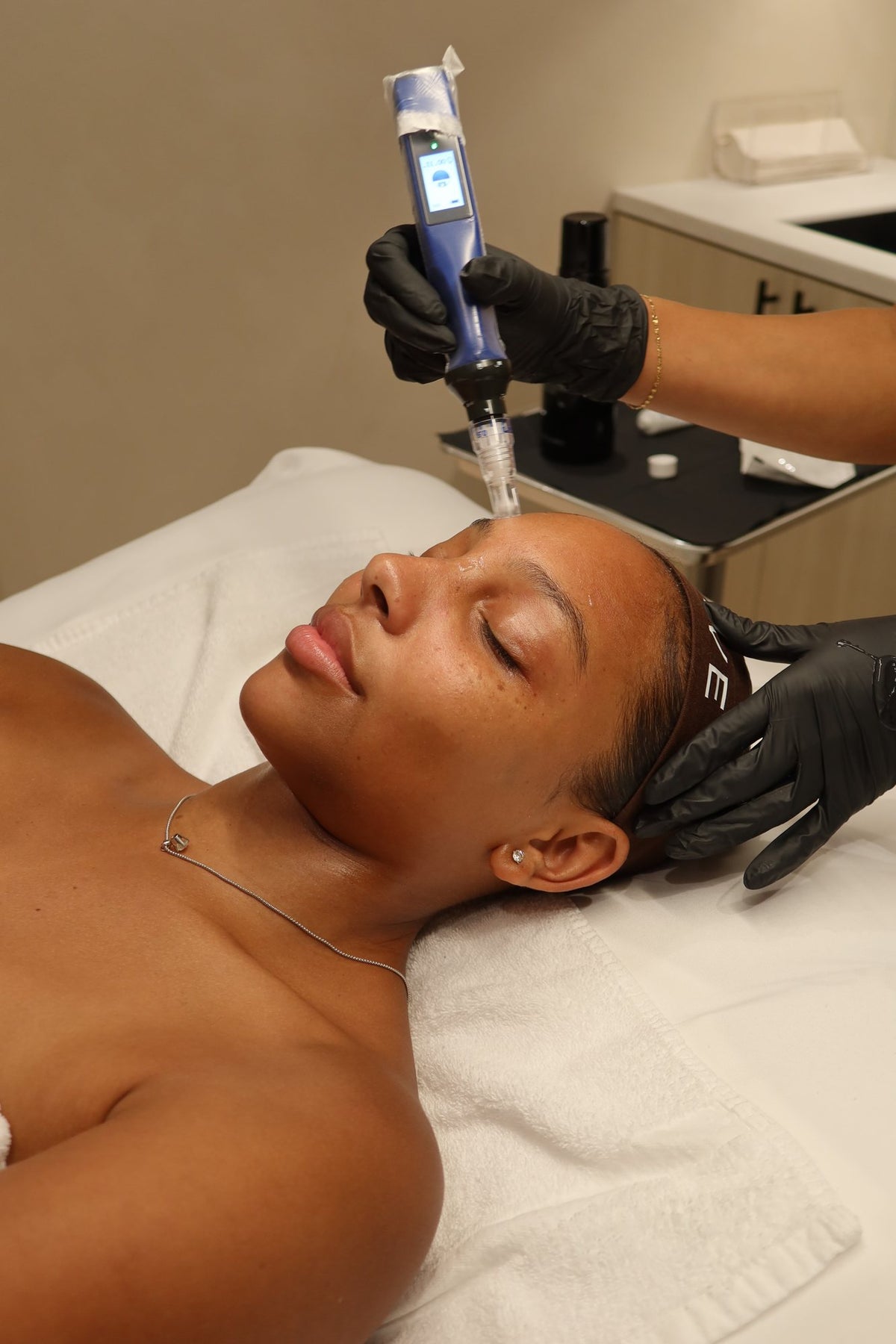
Microneedling for the Neck & Décolleté in Atlanta, GA
People look after their face for decades and stop at the jawline. The neck and chest get the same sun, the same years, and none of the attention — and because the skin there is thinner and heals more slowly, the difference eventually announces itself. Microneedling in this region is the same principle applied with genuine caution: shallower, spaced further apart, and honest about what it can reach. Treated properly it improves crepiness and texture. Treated like a face, it causes problems.
The Benefits
The Area Faces Forget
It treats the region most people neglect for decades, where the mismatch with a well-maintained face eventually becomes the thing that gives the game away.
Built For Thin Skin
The protocol is adapted to the anatomy — shallower depth, lighter pressure, longer intervals — rather than applying facial settings to skin that cannot tolerate them.
Conservative By Necessity
Conservative parameters are a deliberate response to how this tissue repairs, given how few hair follicles and sebaceous glands it has to regenerate from.
Crepiness And Lines
Crepey texture and fine lines are the realistic targets, and they are the changes patients most consistently report after a completed course.
Sun Damage Shows Here
It addresses the rough, uneven texture left by decades of largely unprotected sun exposure on the chest, which is where that damage shows first.
No Heat Involved
Because it works by mechanical injury rather than heat and does not target pigment, it avoids some of the mechanisms by which energy-based devices cause problems in deeper skin tones.
Slower, Deliberately
Sessions are spaced further apart than facial protocols by design, so the course is longer and slower — which is the correct pace for this tissue rather than a compromise.
Honest About Limits
It is honest about its limits: it improves skin quality, and it does not lift, tighten loose skin, or soften muscular banding.
Real Results
Before & After
 After
After Before
 After
After Before
 After
After Before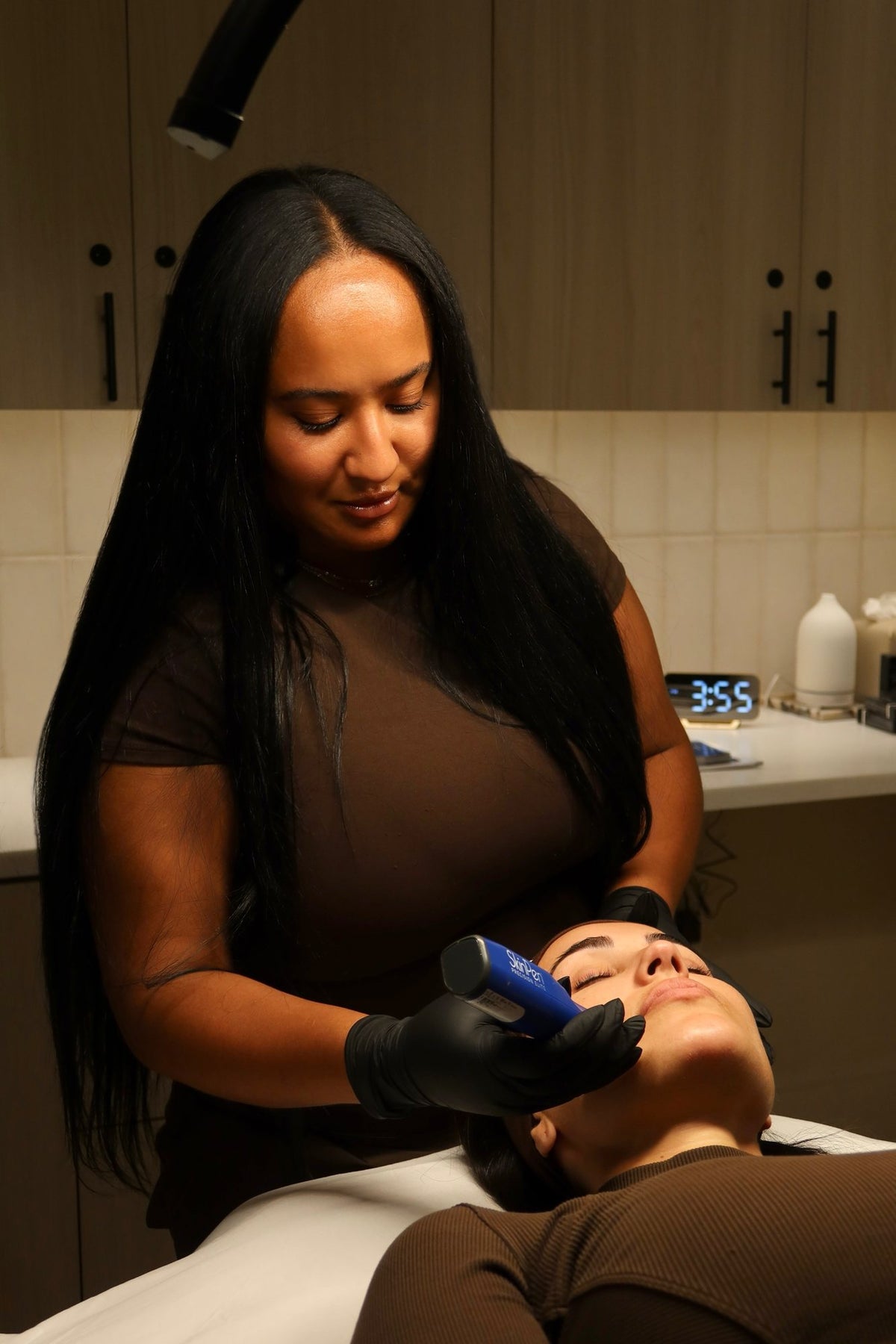
What Microneedling for the Neck & Décolleté Is
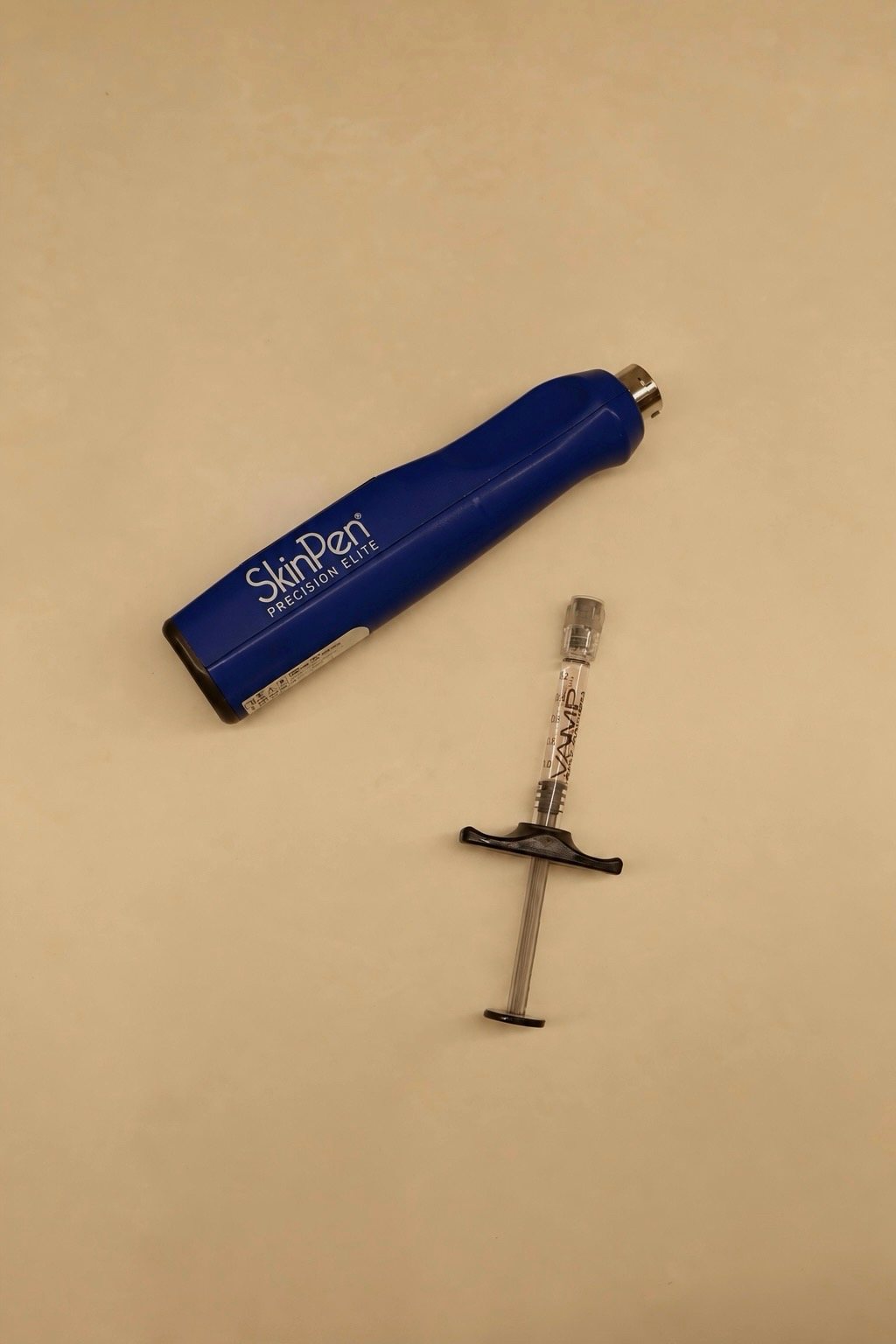
Microneedling uses a device with fine, sterile needles oscillating at a controlled depth to create thousands of narrow columns of micro-injury. The injury is the mechanism: the skin's wound-healing response drives fibroblast activity and new collagen production, remodeling the dermis across the months that follow. On the face this is a well-established treatment for texture, early laxity, and atrophic scarring. On the neck and chest it is the same procedure with meaningfully different parameters, and the differences are not a matter of preference.
The skin of the neck and décolleté is anatomically distinct from facial skin in ways that matter for any procedure that injures it deliberately. The dermis is thinner. Subcutaneous support is limited. Most importantly, there are fewer adnexal structures — hair follicles and sebaceous glands — and those structures are the reservoirs from which the skin surface regenerates after injury. Fewer of them means slower re-epithelialization, slower healing, and a materially higher risk of scarring if the treatment goes too deep.
This region also carries a distinct pattern of damage. The chest in particular is exposed to sun for decades with almost no protection, and the resulting picture — mottled redness, brown pigment, and a fine crepey texture across the upper chest — is common enough to have its own name in dermatology. Horizontal creases across the neck, sometimes deepened by years of looking down at a screen, are a separate concern with a separate answer.
What this means practically is that neck and chest needling is performed at shallower depths than facial treatment, with sessions spaced further apart, and with more conservative expectations. It is often chosen precisely because it involves no heat and does not target pigment, which makes it a reasonable option across a wider range of skin tones than some energy-based devices. Microneedling devices are FDA-cleared for defined indications; treatment of specific body areas may fall outside a given device's cleared indication, which is a fair thing to ask about directly.
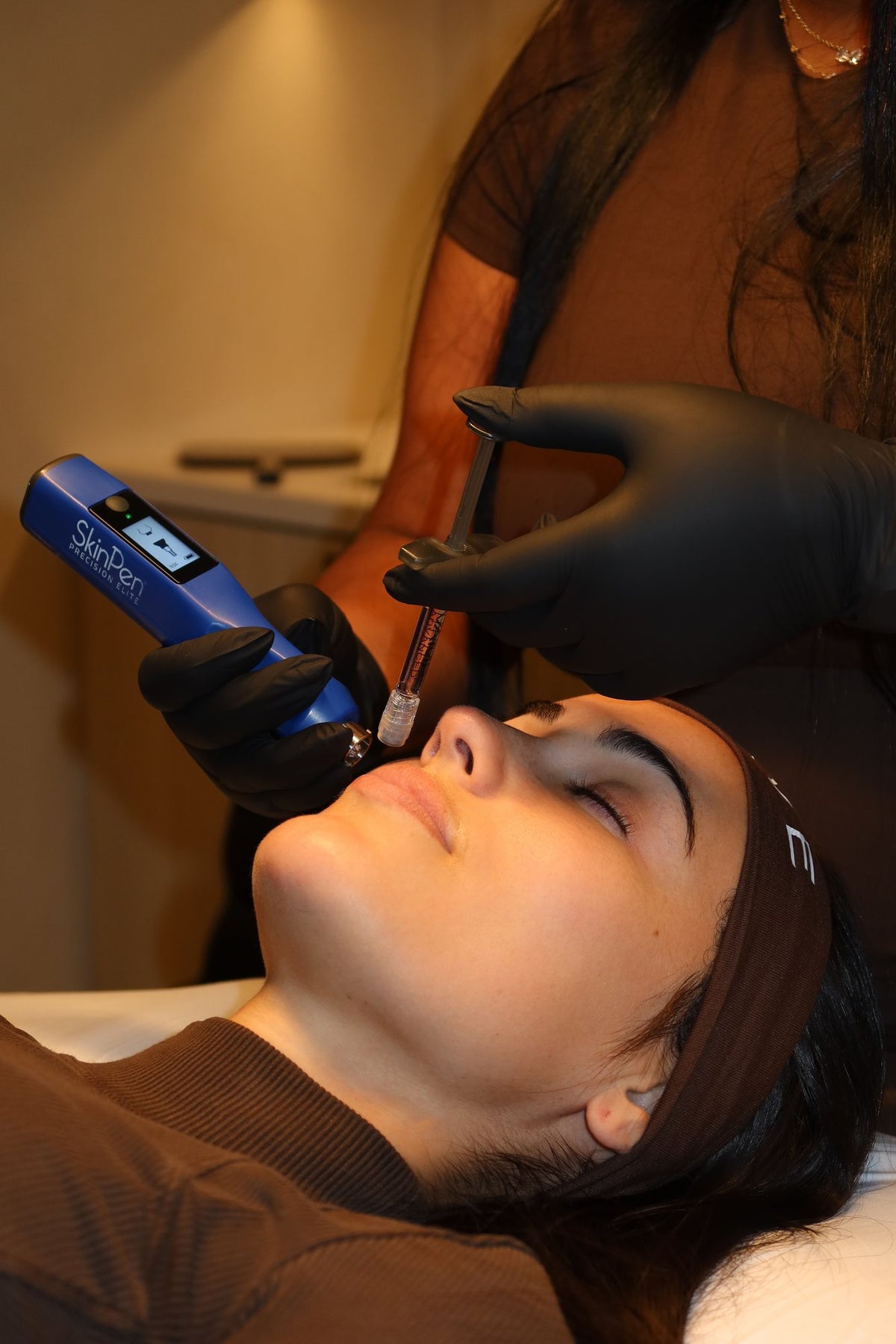
How It Works
The device passes across the skin with fine needles working at a set depth, creating thousands of narrow channels of controlled injury. Each closes quickly, but the tissue registers the damage and begins the wound-healing cascade: an inflammatory phase, a proliferative phase in which fibroblasts multiply and lay down new collagen and extracellular matrix, and a remodeling phase lasting months in which that tissue is reorganized and strengthened. That remodeling is what thickens the dermis and improves texture, and it is why visible change takes months rather than days.
What differs here is depth and pacing, and both differences trace back to the same anatomy. Re-epithelialization after any skin injury proceeds largely from the adnexal structures — hair follicles and sebaceous glands — which act as reservoirs of cells that migrate across the wound and close it. Facial skin is dense with these structures, which is why it heals quickly and tolerates relatively aggressive treatment. The neck and chest have far fewer, so the same depth setting that is routine on a cheek leaves the neck healing slowly and at real risk of scarring. Conservative depth is not caution for its own sake; it is a response to how this tissue actually repairs.
The thinner dermis compounds the point. There is simply less tissue between the surface and the structures beneath it, which narrows the margin between an effective treatment and an excessive one. Practitioners generally work at reduced depth, with lighter pressure, and often across more sessions to achieve what fewer would achieve on the face.
Pacing follows from the same constraint. Collagen remodeling continues for months after a session, and slower-healing skin needs longer to complete it. Intervals between sessions in this region are typically longer than facial protocols, and pushing them shorter does not accelerate the result — it accumulates injury in tissue that has not finished repairing the last round.
One further point: because needling relies on mechanical injury rather than heat, and does not target pigment as a chromophore, it avoids the specific mechanisms by which some energy-based devices cause pigmentary problems in deeper skin tones. That is a genuine advantage in this region, though post-inflammatory hyperpigmentation remains a risk that conservative technique and sun protection are meant to manage.

What Microneedling for the Neck & Décolleté Treats
Crepey texture on the neck and chest
The clearest indication. Skin that has become thin, finely wrinkled, and papery is exactly what a collagen-induction approach targets, and it is the change patients most often report from a completed course.
Fine lines across the décolleté
The vertical creases that appear on the upper chest, often noticed first on waking or in a photograph. These respond to dermal remodeling, though deeper set creases respond less than fine ones.
Horizontal neck lines
Improvement is realistic for the finer creases. Deep, long-standing horizontal bands are structural and generally respond only partially — this is worth establishing honestly before a course starts rather than after.
Rough or uneven texture from sun exposure
Decades of largely unprotected exposure leave the chest rougher and less even than the face. Remodeling the upper dermis changes how light falls across it.
Overall skin thickness and resilience
The underlying goal in this region: a dermis with more collagen behaves better and looks less fragile. This is a slow, cumulative change assessed at the end of a course.
Acne scarring on the chest and back
Treated with the same principle at conservative depths. These areas heal more slowly than the face and generally need more sessions for less change, so expectations should be set accordingly.
Stretch marks and scarring elsewhere on the body
The same approach is applied off the face and neck, with the same caveat about slower healing and more modest results in body skin.
Not laxity, banding, or sagging
Listed deliberately. Loose skin that hangs, and the vertical cords that stand out when the neck is tensed, are not skin-quality problems. Needling will not lift either, and anyone promising that is overselling.
Is Microneedling for the Neck & Décolleté Right For You?
You May Be A Good Candidate If
- Adults with crepey, finely lined, or thin-looking skin on the neck or décolleté who want improvement in skin quality rather than lifting or tightening.
- People whose chest shows the rough, uneven texture that follows decades of sun exposure, and who are willing to protect it going forward.
- People with fine horizontal neck creases, who understand that deep long-standing bands respond only partially.
- People with realistic expectations about pace. This region heals slowly, the course is longer than a facial one, and results are assessed at the end of it.
- People able to commit to sessions spaced further apart than facial treatment, and to maintenance afterward.
- People across a range of skin tones, since the mechanism does not rely on heat or on targeting pigment — though the risk of post-inflammatory pigmentation is still discussed and managed.
- People willing to commit to rigorous sun protection on the treated area, which matters more here than almost anywhere given the exposure this region receives.
- People in generally good health, with any chronic condition well controlled, as assessed at a medical consultation.
This May Not Be Right For You If
- Anyone with a history of keloid or hypertrophic scarring. This is a firmer contraindication here than on the face, because this region heals more slowly and the chest is a recognized site for keloid formation.
- Anyone with an active skin infection, an open lesion, or an active herpes simplex outbreak in the treatment area, until it has resolved.
- Anyone with active inflammatory or cystic acne in the area, which is treated first — needling through active acne can spread bacteria and worsen it.
- Anyone with an active inflammatory or autoimmune skin condition affecting the area — eczema, psoriasis, or rosacea in flare — until it is controlled.
- Anyone currently or recently taking isotretinoin, where the timing of any needling procedure must be discussed with the prescribing clinician. This matters more in slow-healing skin.
- Anyone with a bleeding or clotting disorder, or on anticoagulant therapy that cannot be safely paused — a decision belonging to the prescribing clinician alone.
- Anyone with a thyroid condition, a goiter, or a known abnormality in the anterior neck, without discussing the treatment plan and the areas to be avoided with the physician managing it.
- Anyone who is pregnant or breastfeeding, since elective procedures are generally deferred and safety data in this context is absent.
- Anyone with a skin cancer or an undiagnosed lesion in the treatment area. The chest is a common site for sun-related skin cancers, and any suspicious lesion needs assessment on its own merits before an aesthetic plan is made.
- Anyone with significant skin laxity or prominent vertical neck cords, for whom this is the wrong treatment. Loose skin and muscular banding are not skin-quality problems.
- Anyone expecting lifting, tightening, or a change in the contour of the jawline or neck.
The consultation for this region should cover two things that face-focused consultations often skip. First, an honest separation of what is skin quality — crepiness, texture, fine lines, which this treats — from what is laxity or muscular banding, which it does not. Getting that wrong is the commonest source of disappointment here. Second, a skin check: the chest is one of the most sun-exposed areas on the body and a common site for skin cancers, so any lesion in the treatment area should be assessed on its own merits rather than treated around. A licensed provider should also ask specifically about keloid history, isotretinoin use, thyroid conditions, and cold sores, and should be explicit about why the depth settings and intervals used here differ from facial protocols.
How Microneedling for the Neck & Décolleté Compares
Neck and chest concerns are frequently misattributed, and the treatments are genuinely not interchangeable. The table separates what each approach addresses in this region.
| Feature | Microneedling (neck/chest) | Neuromodulator | Injectable skin boosters | Energy-based tightening |
|---|---|---|---|---|
| What it addresses | Skin quality — crepiness, texture, fine lines, dermal thickness | Vertical neck cords and some horizontal lines driven by muscle | Hydration and skin quality via injected material | Laxity and mild tissue tightening |
| Mechanism | Controlled micro-injury drives collagen remodeling | Temporarily reduces contraction of the underlying muscle | Places hydrating or biostimulatory material into the dermis | Delivers energy to heat tissue and prompt contraction and remodeling |
| Effect on loose, hanging skin | None meaningfully | None | None | Modest, device-dependent, and often oversold |
| Effect on crepey texture | This is its main target | None | Direct, particularly on hydration and suppleness | Variable |
| Heat involved | No | No | No | Yes — which is the source of much of its risk profile |
| Considerations in deeper skin tones | Generally suitable; pigmentary risk managed by conservative technique | Not pigment-related | Not pigment-related | Requires more caution with some device types |
| Downtime | Redness for a day or two, then dryness and flaking, over a longer course | Minimal; small injection marks | Visible bumps for hours, then bruising | Varies considerably by device and setting |
| Pace in this region | Slower than facial protocols by design | Onset within days, wears off over months | A series with maintenance | Varies; results often gradual |
These are often combined rather than chosen between, because the neck and chest usually present more than one problem at once — skin quality, muscular banding, and laxity can all be present in the same person. Treating them as separate problems with separate answers produces a better result than asking one modality to solve all three. Which combination applies to you is a clinical assessment made in person.
What To Expect
Before The Treatment
- A consultation that separates skin quality from laxity and muscular banding, since only the first is what this treatment addresses and confusing them is the commonest source of disappointment.
- A skin check of the treatment area. The chest is heavily sun-exposed and a common site for skin cancers, so any lesion should be assessed on its own merits before an aesthetic plan is made.
- A full medical history and review of medications and supplements, with specific questions about keloid or hypertrophic scarring, isotretinoin use, thyroid conditions, cold sores, bleeding disorders, and pregnancy.
- An explicit explanation of why the depth settings and session intervals used here differ from facial protocols, and what that means for the length of the course.
- Instructions to stop retinoids, exfoliating acids, and other active skincare for a period beforehand, and to avoid sun exposure and self-tanner in the run-up. Sun exposure matters more here than on the face because this region gets more of it.
- Guidance on pausing blood-thinning medications and supplements where your prescribing clinician confirms it is safe. Never stop a prescribed medication on your own.
- Instructions to arrive with clean skin in the area, free of makeup, sunscreen, self-tanner, and body products, and to wear clothing that gives access to the chest and neck without rubbing afterward.
Results: Onset And How Long It Lasts
Change here is slower than on the face, and that is a feature of the anatomy rather than a shortcoming of the treatment. The first week is recovery: redness, then dryness and light flaking as the surface turns over, generally over a longer window than facial treatment would take. Meaningful change develops across months as collagen is laid down and the dermis remodels, and it is assessed at the end of a course rather than after any single session. What patients most often describe is skin that looks less crepey and papery, with finer lines softened and a more even texture across the chest. What the treatment does not do is lift loose skin, tighten a sagging jawline, or soften the vertical cords that stand out when the neck is tensed — those are laxity and muscle problems with different answers, and confusing them with skin quality is the commonest reason people are disappointed here. Deep, long-standing horizontal neck creases respond partially at best. Response varies between individuals and with the extent of accumulated sun damage, and results in this region are generally more modest than the same course would produce on the face. This page publishes no numeric outcome figures, because protocols and depths vary between practices and averages would tell you nothing reliable about your own skin. Sun exposure continues, so maintenance and daily protection are both part of holding a result.
During The Treatment
- The area is cleansed and topical numbing cream is applied and left in place, typically for around half an hour.
- The needling device is passed across the neck and chest at a conservative depth chosen for this tissue, with lighter pressure than facial treatment.
- Specific areas may be deliberately avoided or treated with additional caution — the anterior neck over the thyroid and areas overlying superficial structures among them.
- The sensation is generally described as scratchy and prickly with a vibrating quality. Many people find the chest more uncomfortable than the face, particularly over the sternum where there is little padding over bone.
- Pinpoint bleeding during treatment is expected, though it is usually less than on the face at these shallower settings.
- A session is generally quick once numbing is complete; the appointment is dominated by numbing time.
- Afterward the area will look red and feel warm and tight, comparable to a sunburn.
How Often, And Why
Neck and chest needling is planned as a longer, slower course than facial treatment. Sessions are typically spaced further apart — often at intervals longer than the four weeks common in facial protocols — because this region heals more slowly and collagen remodeling needs to complete before the tissue is injured again. Compressing that schedule does not accelerate the result; it accumulates injury in skin that has not finished repairing.
The number of sessions is generally higher than a facial course for a more modest degree of change. That is not a failure of the treatment but a consequence of thinner dermis, fewer adnexal structures, and decades of accumulated sun exposure in a region that received almost no protection. A realistic plan is a course of several sessions across a number of months, with the result assessed at the end rather than session by session.
Maintenance afterward is typically at intervals of several months to a year. Sun exposure to this area continues regardless of what is done in a treatment room, which makes daily broad-spectrum protection at least as important as the maintenance sessions themselves — arguably more so. A course of needling with no change in sun habits is treating the consequence and leaving the cause running.
Where the neck and chest present more than one problem — skin quality alongside muscular banding or laxity, which is common — this is one element of a plan rather than the whole of it, and the sequencing of the others is decided at consultation.
Afterward
- Expect redness and warmth for a day or two, sometimes longer than the face would take, with the skin feeling tight and sensitive.
- Expect healing to be slower than you may be used to from facial treatment. This region simply repairs more slowly, and that is anatomy rather than something going wrong.
- Leave the area alone for the first several hours and follow the specific interval your provider gives you before washing. Use lukewarm water and clean hands.
- Avoid all active skincare — retinoids, exfoliating acids, vitamin C, and physical scrubs — until your provider clears you.
- Expect dryness, roughness, and light flaking over the following several days as the surface turns over. Let it shed rather than picking or exfoliating it.
- Wear loose clothing that does not rub the treated area, and avoid necklaces, collars, and bag straps across the chest for the first days.
- Avoid strenuous exercise, saunas, steam rooms, hot tubs, and swimming pools for the period you are given. Sweat pooling in the neck creases is worth avoiding specifically.
- Protect the area from sun rigorously and use broad-spectrum sunscreen once cleared to apply products. This matters more here than on the face — the chest gets more exposure and post-inflammatory pigmentation is a real risk.
- Do not judge results after one session. This is a longer, slower course than facial treatment by design, and outcomes are assessed at the end of it.
- Report anything worsening rather than settling after the first few days — spreading redness, increasing pain, warmth, pus, or fever — promptly.
Side Effects And Downtime
Common And Expected
- Redness and warmth for a day or two, often persisting slightly longer than it would on the face
- Tightness, sensitivity, and a rough texture in the treated area
- Mild swelling, particularly across the upper chest
- Pinpoint bleeding during the procedure and small scabs or dry flaking in the days afterward
- Dryness and light peeling as the surface turns over, typically across several days
- Itching during healing, which should not be scratched
- Discomfort from clothing, necklaces, collars, or bag straps rubbing the treated area
- Temporary small blemishes or congestion on the chest in the days afterward
When To Seek Care
- Signs of infection: increasing rather than decreasing pain, spreading redness, warmth, swelling worsening after the first few days, pus or discharge, or fever.
- Redness spreading outward in streaks, which can indicate a deeper soft-tissue infection and needs same-day assessment.
- Severe or worsening pain out of proportion to what you were told to expect.
- Any area that blisters, ulcerates, or fails to heal within the expected window. Slow healing in this region makes prompt assessment more important rather than less.
- A raised, firm, or thickening area developing in the treated skin, which may indicate hypertrophic or keloid scarring and should be assessed early rather than watched.
- Linear marks or tracks appearing in the treated skin that do not settle within the expected recovery period.
- Signs of an allergic reaction — hives, swelling of the face, lips, tongue, or throat, or difficulty breathing. Call 911. Numbing agents and antiseptics can cause reactions.
- Any new or changing lesion in the treated area, which should be assessed on its own merits rather than attributed to recent treatment.
Less Common, But Important To Know
- Scarring. This is the risk that most distinguishes this region from the face, and it is why depth settings are conservative. With fewer hair follicles and sebaceous glands to regenerate from, skin here heals more slowly and treating too deeply carries a real risk of leaving a mark rather than removing one.
- Keloid or hypertrophic scarring in anyone predisposed to it. The chest is a recognized site for keloid formation, which is why that history is a firm contraindication here rather than a caution.
- Post-inflammatory hyperpigmentation — temporary darkening of treated skin — more likely in deeper skin tones, and a particular risk in a region that receives heavy sun exposure. Rigorous sun protection afterward is the main defense.
- Prolonged redness lasting well beyond the expected window, which this region is more prone to than the face.
- Infection at the treatment site — uncommon with sterile technique, but a genuine risk any time the skin barrier is broken across a large area, and one that matters more where healing is slow.
- Reactivation of herpes simplex producing an outbreak, in anyone with a history of it in the treated area.
- Tram-track marks or linear scarring from incorrect device technique, depth, or pressure — a technique-dependent complication, and the reason experience with this region specifically is worth asking about.
- Acneiform eruption or folliculitis on the chest following treatment.
- Delayed healing, particularly in smokers, in people with diabetes, and in anyone whose circulation or immune function is impaired.
- No meaningful improvement, which is a realistic outcome where the dominant problem was laxity or deep structural creasing rather than skin quality.
Downtime
Expect visible recovery across several days, and expect it to run slightly longer than facial treatment would. The first day or two the area looks red and feels warm and tight, much like a sunburn, with some swelling across the upper chest. Over the following several days the redness fades and the skin becomes dry and rough and begins to flake as the surface turns over. The practical complications here are clothing and sun. Necklaces, collars, and bag straps rub freshly treated skin and are worth avoiding for the first days, and loose clothing is genuinely more comfortable. Sun protection matters more than on the face, because this is a region that gets heavy exposure and because post-inflammatory pigmentation is a real risk. Exercise, saunas, steam, and swimming come back on the timeline you are given — sweat pooling in the neck creases is worth avoiding specifically. Most people work through this without difficulty, but a scoop neck and a sunny weekend are both worth planning around.
Who Performs This Treatment

Brianna Harris
Aesthetician · Facials, peels, microneedling and resurfacingBrianna is one of Alcove's aestheticians. Every treatment starts with a look at your skin and what you want from it, and your plan, including what you use at home, is built from there.

Shaina Paul
Aesthetician · Facials, peels, microneedling and resurfacingShaina is Alcove's aesthetician. Every treatment starts with a look at your skin and what you want from it, and your plan, including what you use at home, is built from there.
Microneedling for the Neck & Décolleté FAQs
Because it does not heal the same way. Skin regenerates after injury largely from hair follicles and sebaceous glands, and the neck and chest have far fewer of them than the face. Add a thinner dermis and limited subcutaneous support and the same depth setting that is routine on a cheek leaves this region healing slowly and at real risk of scarring. Conservative depth here is a response to anatomy, not caution for its own sake.
No, and this is the most important expectation to set. Microneedling improves skin quality — crepiness, texture, fine lines, dermal thickness. Loose skin that hangs is laxity, and the vertical cords that stand out when you tense your neck are muscle. Neither responds to needling. Confusing skin quality with laxity is the commonest reason people are disappointed by this treatment.
Partially. Fine horizontal creases often soften as the dermis thickens. Deep, long-standing bands are structural and generally respond only modestly at best. It is worth establishing honestly which kind you have before a course starts rather than discovering it at the end.
Slower, and slightly longer. Expect redness and warmth for a day or two — sometimes a little longer than the face would take — then several days of dryness and flaking as the surface turns over. The practical annoyances are specific to the region: necklaces, collars, and bag straps rub, loose clothing is genuinely more comfortable, and sun protection matters more than it does on the face.
Generally more than a facial course, for a more modest degree of change, spread across a longer period. Sessions are spaced further apart than facial protocols because this tissue needs longer to complete its remodeling before being treated again. A realistic plan is several sessions across a number of months, with the result assessed at the end.
Microneedling is generally considered a reasonable option across skin tones, since it relies on mechanical injury rather than heat and does not target pigment as a chromophore — which avoids some of the mechanisms by which energy-based devices cause pigmentary problems. The relevant risk is post-inflammatory hyperpigmentation, managed with conservative depth, careful technique, and rigorous sun protection afterward.
Many people find the chest more uncomfortable, particularly over the sternum where there is very little padding between skin and bone. Topical numbing is applied and left in place beforehand, and the shallower depths used here work in your favor. The sensation is scratchy and prickly with a vibrating quality, and it is brief.
Only partially, and it is not the modality most associated with that pattern. The mottled redness and brown pigment that follows decades of sun exposure on the chest usually responds better to treatments that target pigment and vessels directly. Needling improves the textural component that accompanies it. A proper assessment should tell you which component is dominant and plan accordingly.
It is a fair question, and a reason to discuss the plan specifically. Practitioners generally treat the anterior neck with particular caution and may avoid certain areas altogether. If you have a thyroid condition, a goiter, or any known abnormality in the front of the neck, raise it at consultation and expect the treatment map to be adjusted rather than assumed.
Yes, using the same principle at conservative depths, and it is a reasonable approach. Expect it to need more sessions than the face for less change, since this skin heals more slowly. Active acne in the area is treated first — needling through active lesions can spread bacteria and worsen things.
That is the specific risk of this region, and it is worth naming. Treating too deeply in skin with few regenerative reservoirs and a thin dermis can leave scarring, tram-track marks, or prolonged healing rather than improvement. It is a technique-dependent complication, which is why it is reasonable to ask how much experience a provider has with this area specifically rather than with microneedling generally.
Yes, and honestly you should have been anyway. This region receives heavy sun exposure, that exposure is the reason most of the damage is there in the first place, and freshly treated skin is more vulnerable to both ultraviolet damage and post-inflammatory pigmentation. A course of needling with no change in sun habits treats the consequence and leaves the cause running.
Pairs Well With

Book Your Consultation
A consultation is a conversation about your face, not a sales appointment. Bring your questions about Microneedling for the Neck & Décolleté and your medical history, and leave with an honest answer about whether it is the right treatment for you.